This article is a case study written for abuse survivors. All names are pseudonyms.
Mai (pseudonym), 19, lives alone in a quiet apartment. Her family consists of her mother and a sister two years younger. Somewhere, she also has two half-siblings with different fathers — though she has never met them.
“The three of us live together” — that’s what the family register says. In reality, her sister barely comes home half the week, and her mother appears only a few days a month, flitting in and out like a stranger passing through.
Her mother drifting away and drifting back again had been the rhythm of Mai’s life for as long as she could remember. That this wasn’t “normal” — she only learned that after she was taken into protective custody.
Chapter 1: The Darkness and the Taste of Ketchup
Mai’s memories of early childhood are always dim. Not as a metaphor — literally dark. The electricity was cut off for non-payment so often it had become routine.
A room with curtains permanently drawn. Or the stifling heat of a car, waiting for their mother to return. That was the entire world of young Mai and her sister.
“I’m hungry.”
Her little sister’s whimpering was a sound Mai had grown numb to. The refrigerator was either empty or smelled of something rotting. The two of them would scavenge through the apartment for “fuel” to keep going.
Half-eaten sweet buns. Dried-out snacks. Expired instant curry. And ketchup, hardened on the kitchen counter. Mai dipped her finger in and licked it. Sweet, faintly sour, a pale taste of tomato.
That is the taste of Mai’s childhood.
Days would pass. Sometimes weeks. Then their mother would reappear, always carrying convenience store bags — rice balls, buns, cup noodles. That was the full extent of her expressions of love.
Chapter 2: Her Sister, Her “Rival”
“Mom!”
Mai wanted to run to her. To talk and talk. But she held back. She had learned: if you cling too much, Mom leaves again. To survive, you had to be a “good girl” who didn’t cause trouble. That childhood instinct put a brake on her feelings.
Her younger sister was different. She followed her instincts — crying, clinging, fighting for their mother’s lap. Watching her, what rose in Mai’s chest was not tenderness, but a dark, visceral resentment.
“Stop it. You’re bothering Mom.” “When you make a fuss, she gets tired.”
Frustration that her sister was consuming their mother’s already-scarce capacity. A desperate need to control what little was available. In their relationship, there was no room for the warm fiction of “older sister protects younger sister.” They were rivals competing for survival.
Chapter 3: Men as a “Lifeline”
Their mother could not live without men. There was always “someone” in her life — paying bills, making phone calls, fixing broken things. When that man disappeared, the electricity went out again. When a new man appeared, food came back to the table. As a child, Mai absorbed this pattern without understanding it.
And so, she came to believe it without question: a woman alone cannot survive.
At the same time, Mai worked to reframe her mother’s absences. Mom isn’t gone. She’s out working. Working far away, to support us. We have to be good girls and wait. By telling herself this story, Mai protected herself from the despair of feeling abandoned.
Chapter 4: Protective Custody — and Confronting the Objective Facts
The breaking point came before Mai started elementary school. Her mother failed to appear at the enrollment orientation and couldn’t be reached. The school and child protective services moved in.
When the adults entered the apartment while her mother was away, someone let out a quiet “Oh god.” Months of garbage, the smell of rot. And most urgently: both girls were severely underweight, malnourished. Immediate protective custody.
When they were separated from their mother, her sister screamed and cried. Mai was strangely calm. Nobody had hit her. Mom had just… not been there. Why were they being “protected”?
Life in the facility was a series of shocks. Meals at regular times. A warm bath. Clean bedding. Oh — so this is what food is supposed to taste like. Wrapped in a blanket in an air-conditioned room, Mai quietly exhaled somewhere inside herself. I don’t have to go drink water in the middle of the night anymore.
Years later, when she left the facility, she was shown a photo from the day she arrived. The girl in the picture — she couldn’t recognize herself. Hollow cheeks. Sunken eyes. Limbs like dry twigs.
“Hardly believed I made it…” Mai let out a wry laugh. There had been neighbors. Why hadn’t anyone noticed? Then again — maybe that was to be expected. Even Mai herself had never once thought: I am unhappy.
Chapter 5: The Curse of Being Unable to Hate
Facility staff and counselors told Mai: “What your mother did to you was terrible.” “Neglect is abuse. You’re allowed to be angry.”
But no matter how many times she heard those words, they didn’t reach her. The other children in the facility had been hit, screamed at, degraded. Compared to that, she hadn’t been beaten.
Mom just couldn’t cook. Couldn’t clean. Couldn’t survive without leaning on a man. That’s all.
“I don’t hate my mother.”
When Mai said that, the adults would look at her as if to say: the brainwashing hasn’t worn off yet.
But Mai’s analysis was different. Her mother had not abandoned them out of malice. She was like a child herself — operating entirely on immediate impulse and a short-sighted survival instinct. “To feed the kids, I need money from a man.” “I don’t know how to clean, so I leave it.” A body that had grown up, but a mind that hadn’t.
There had been no sophisticated “intention to neglect.” She and her sister had simply been kept as pets by this oversized child. Can a pet hate its owner for being incompetent? All you can do is accept you were unlucky.
Chapter 6: “Acceptance” as a Survival Strategy
“I don’t hate her.” Telling herself this had been Mai’s greatest act of self-preservation — the defense mechanism that carried her through a brutal childhood.
If she had ever admitted “Mom didn’t love me, that’s why she left us,” her sense of self would have shattered. Amid hunger and loneliness, the one sliver of hope was the story: Mom is trying her best for us. It was fiction. But it was the only way to survive the terror of those dark rooms.
And so, even now, she cannot hate. Because if she did, she would be betraying the desperate little girl she once was.
By defining her mother as “a sad, incapable person who needed everyone’s help,” and positioning herself as “the one who understands,” Mai barely holds onto her self-respect.
“My mother was a weak person. She needed men, she needed help from everyone. So it couldn’t be helped.”
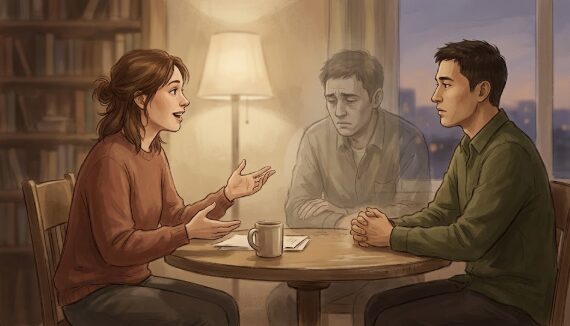
Nineteen-year-old Mai says this quietly, without affect. Behind her eyes is a still light — something between acceptance and resignation.
She has forgiven her mother. Or perhaps more precisely: she has chosen not to stop forgiving. That is the sad, but quietly wise, survival strategy she chose to protect her own heart.
Mai’s case illuminates a question that is, in truth, universal.
“Not Being Able to Forgive” Is Not Weakness (A Note on Forgiveness)
When abuse survivors say “I don’t hate my parents” or “I’ve already forgiven them” — it’s worth pausing to ask: what lies beneath those words?
In therapeutic settings, “forgiving your parents” is sometimes treated as the goal of recovery. Phrases like “let it go” and “forgiveness will set you free” appear in counseling. But this advice can become a burden for survivors — because it implies: if I haven’t forgiven, I haven’t healed yet.
Here is a different way to see it.
People who struggle to forgive their parents are not people who lack the strength to forgive. They are people who have already forgiven, and forgiven, and forgiven again — and have finally reached their limit. It is not weakness. It is that they have forgiven too much for too long.
When Mai kept saying “I don’t hate her,” it may not have been because there was no hatred. It may have been because she could not allow herself to feel it. “I have to love this parent, no matter what.” “Hating is wrong.” These beliefs may have kept a lid on her true feelings for years.
The feeling of “not being able to forgive” is not something to erase. It is evidence that you have finally begun to recognize: what happened to me was wrong. There is no need to rush to let that feeling go.
Comments