For You, Who Have Spent Your Life Pretending to Be “Normal” — The Hidden Struggle of Abuse Survivors

I want to be “normal.”

For as long as I can remember, I have wished for it — like a prayer, or sometimes like a curse.

But what is “normal”? When I try to put it into words, the definition slips through my fingers like sand. Is it the families on TV, gathered around a table on the weekend, smiling? Is it the gratitude my friends post about their parents on social media? Is it that unfounded sense of safety — believing, for no particular reason, that tomorrow will come?

To be honest, I don’t really know.

There is one thing only that I know for certain. I am not “normal.”

TOC

Chapter 1 — The Invisible Wall of “Only I Am Different”

Walking through the city, sometimes my feet stop on their own. People crossing the intersection. Students laughing together, parents and children holding hands, office workers tired but hurrying home.

Each of them seems to be living with something colorful called “emotion” circulating through their veins. I alone am different. I should be in the same space, breathing the same air. And yet, between me and the world, there is a thick, cold “invisible wall.”

The devices that everyone else takes for granted — “safety,” “love” — I don’t have them. Was a critical part missed somewhere on the assembly line? Did something short-circuit on initial inspection? I am defective in some way — that sense has been driven into my spine like a cold stake.

So I made a desperate choice: hide it. So that no one would notice I was a “foreign body.” I put on a precise mask: pretending to be “normal.” When the people around me laugh, I lift the corners of my mouth half a beat behind. When someone says, “that’s sad,” I lower my eyebrows in an imitation of empathy.

This is the desperate camouflage of survival inside the herd that is society. Hold the breath. Don’t stand out. Don’t make waves. Don’t ask for anything. Don’t dare to ask for anything. I never want to feel again the pain of having my hand slapped down the moment I reached out for something I wanted. So, from the start, I trick myself into “I don’t want it.”

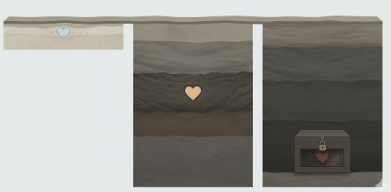
There is no need to feel anything at all. Emotion is noise — it gets in the way of survival. Sadness, anger, even joy — I shut them all into a lead box deep inside my chest, and lock it. I have to keep telling myself that, or I will not make it through today.

Chapter 2 — Your Pain Is Not a Defect

If, while reading this, you found yourself thinking, “This is about me” — please let us sit beside you.

Not face-to-face. Not reaching down to you from above. Just looking the same direction, at a small distance, sitting next to you.

And let us say this much:

Your pain is, in no way, strange.

The reason you could not become “normal” is not that there is some system error inside you. The function in you that “tries not to feel anything” is not there because you are “weak,” and not because you have a “bad personality.”

It was a “survival strategy” you yourself built — extraordinarily capable, sadly brave — to live through a brutal environment.

Your effort, your anxiety, your numbness. The pain you swallowed when there was no one you could say it to. The suffering, the sadness, and the magma of anger underneath. None of these are evidence of a defect in you. Each of them deserves to be handled with care — they are the proof that you have been fighting.

You know how frightening it is to hope for anything from another person. You remember the sound of a heart, held out with shaking hands, being trampled — at the moment you had finally let yourself believe, “this time will be different.” That despair — that feeling of the ground giving way, of the color draining out of the world. The fact that “home” — what should have been the safest place in the world — was, for you, the most dangerous of minefields.

Inside that battlefield, you survived. With a small body, you scraped together wisdom, read the room, and did everything you could. And you have lived through to this day.

So the feeling that “people are frightening” makes sense. The feeling that “trusting is frightening” is proof that your defensive instincts are working the way they should.

Chapter 3 — What This Site Can and Cannot Do

So we are not going to ask you, against your wishes, to “trust us.” We will not say something as irresponsible as “open your heart now.” We only want, quietly, to know what happened. What you were really feeling back then. The story you have been so desperately hiding.

Thank you for reading this far. Finally, let us say a little about ourselves.

We are not gods, and we are not magicians either. We cannot erase your past, the way a spell would. And in fact, we do not believe it is “we” who change you. People heal and are reborn — not because someone changes them. It happens only when the “power to recover” you already carry begins to sprout inside a place that is safe.

All we do is prepare the soil for that. We become a roof against the rain and wind. We are stagehands who lend a little support — no more.

We also have to confess: we are still developing. The territory of the human heart is as deep as the cosmos, and there are places where our skill may still fall short. We are still inside our own research, learning alongside you.

We also want to make this place sustainable. Whether any of this will hurt you, whether we will betray a small hope that has only just begun to sprout — that worries us, always.

Even so, we cannot help writing. Pretending you do not exist, treating you as someone unrelated, finishing our lives that way — that is something we cannot bring ourselves to do.

Why “normal parents” never abuse — that question becomes clearer when we know what an abusive parent does not have.

Chapter 4 — In Order to Know What “the Storm” That Tormented You Really Was

Up to here, we have looked at the survival strategies built up inside an abusive environment, and the cost of carrying them around. From here, we go deeper into how those effects show up in adulthood — in your life right now.

There is one thing we want to convey with full conviction.

What you were forced to bear was not a flaw in your character, and not a lack of effort. It was not because you were “a bad child,” not because you were “a defective human.”

It was more like an unavoidable disaster. Behind it, there may have been structural causes that no one could do anything about. To the small child you were, it was an unstoppable “storm” — something that could not be resisted.

Inside that storm, you stood alone, without an umbrella. And yet you have kept blaming yourself: “I am wet because I did not try hard enough.”

Let us put an end to that.

We want to untangle, together with you, the true nature of that “cause.” Not with emotional appeals or moral platitudes — but in the light of logic and fact, setting down, one by one, the unjust burden you have been carrying for so many years.

When the burden is set down, what will you find yourself feeling? What landscape will be in front of you? We are deeply curious about that future.

We hope this meeting between you and us becomes a first step toward a quiet kind of peace.

Why “Normal” Eludes You — Because You Have Never Lived It

To you, who have so deeply wished to become “normal,” there is something we want to say. The reason “normal” eludes you is not that you are too suspicious, nor that your imagination is too small.

What it feels like to have a home where you can simply be at ease. What it feels like to be able to relax into your true self with someone, holding nothing back. Even if you know about these things from television and books, the felt sense of them does not exist inside your body. It is the same as learning a foreign language only through translation pairs, never once visiting the country — the culture and the atmosphere stay outside the felt sense.

So if you want to know “normal,” it may begin with accumulating small experiences of “safety” inside a safe place. Learning the definition of “normal” matters far less than the experience of feeling it for the first time.

The Memory of Being Forbidden to “Lean on Anyone” Slows the Recovery

Many people who have spent their lives pretending to be “normal” come, over time, to feel a quiet aversion to “leaning on anyone” of any kind. Asking for help is “weakness.” Putting suffering into words is “blowing things out of proportion.” Acknowledging your own pain is “indulgence.” That is how it gets framed.

This Is Not Your Personality

Behind it lies a history of having your small requests trampled, again and again. You learned that “wanting” itself was dangerous — that is why you have come to control emotion this tightly.

The “No Leaning Allowed” Rule That Blocks Recovery

On the road to recovery, this “no leaning” rule becomes one of the largest barriers. Recognizing that you are wounded, asking for support, gradually entrusting yourself to safety — these are not signs of “weakness.” They are healthy capacities that human beings are originally meant to have. What forbade them was the environment you were placed in. It was not your own decision.

What Sat Behind “I Cannot Quite Get It Right”

“I can’t read the room.” “My relationships don’t last.” “I can’t keep up with the flow in a group.” People who have felt this way often, for years, end up suspecting they may have a developmental disorder.

But some of these difficulties are not, in fact, problems of inborn neural development. They come from never having had the experience of “being safely connected with someone.”

A person who grew up with attachment difficulty does not, as a felt sense, know how to manage distance with others. Inside the relationship with a parent, getting close brought wounds, and moving away brought abandonment — over and over. In that repetition, the inner sense of “distance with another person” grew distorted. The difficulties that come out as “can’t read the room” or “relationships don’t last” are, on the surface, almost indistinguishable from a developmental disorder.

What you have felt as “I can’t quite get it right” may not be a problem of ability, and not a problem of the brain. It may simply be that you never had the chance to learn what “a safe relationship” is.

Chapter 5 — Why People “Collapse” During Recovery

Why Fear Comes First, When the Long-Held Endurance Begins to Shift

When the long-held “endurance” begins to shift, even a little, the experience does not arrive as something simply joyful. For the person inside it, the thawing of emotion is more often experienced as intense fear before it is experienced as relief.

A child who grew up with abuse arrives, after a long time, at the state of “I will not expect love anymore.” After expecting and being betrayed, expecting and being betrayed, the child reaches a quiet decision: “I will not expect anything anymore. I will live without expectation.” This endurance gets hardened over many years. Suppressing emotion was a life-and-death choice — a way of not being hurt.

The reflex of refusing care that someone offers is not hostility toward the supporter. It comes from fear that the equilibrium built at the risk of one’s life is about to be lost.

When this fear shows up in the recovery setting, it is often experienced as inexplicable swings of emotion, or a sudden refusal. Suddenly wanting to put distance between oneself and the supporter, finding oneself unable to speak about what one had been speaking about moments ago, tears arriving without warning — these are all signs that the defense of “not feeling, in order to stay alive” is, for the first time, beginning to shake.

The capacity for the heart to connect with another’s heart is, by rights, built up between parent and child in early childhood. For a survivor to gain it, it has to be grown — slowly — in adulthood, through a continuous relationship with one person.

A person who believed “once I recover, things will get easier” can suddenly find themselves unable to move in the middle of recovery. This is a reality that comes up, again and again, in the words of people who have lived through recovery from abuse.

What “Collapse” Looks Like

The recovery process often contains a phase called “collapse.” The mind goes blank; words on the page do not register; sleep is endless; there is nothing left to say; things one had been writing become impossible to write. Seen from outside, this period looks like deterioration. In fact, it is a sign that healing has gone deeper.

The Eye of the Typhoon — In Survivors’ Words

One survivor described it this way: “I was walking toward the typhoon, and before I knew it, I was inside the eye. Quiet — while everything around me was a storm.” The collapse phase of recovery is the state of being at the center of an emotional storm itself. From the outside, it looks calm. Inside, what has been sealed for years is finally beginning to move.

Collapse Is Not Regression. It Is Going Deeper.

Collapse is rarely a one-time event. It comes in waves — stillness, then a wave, then stillness again. Each time, the depth of what is being processed deepens. What can look like regression to outside eyes is, in fact, a natural part of going further into oneself.

Chapter 6 — What “Self-Acceptance” Really Means

“Accept yourself” is a phrase one hears often these days. But for a person who grew up with abuse, this phrase carries a far more complicated meaning than it appears.

What “Self-Acceptance” Means for a Survivor

For a survivor of abuse, self-acceptance is not the same as “thinking positively.” It is not “becoming an optimist.” It is, instead, knowing — for oneself — how hard it was, and how hard one has worked to stay alive through it.

Why Self-Acceptance Feels “Frightening”

Many people feel that self-acceptance is frightening. There is a sense of “if I do that, I will become empty.” There is a sense of “I will have to give up on my parent.” Someone who has lived for a long time by “not expecting love and pushing through” feels, when setting that method down, as if the very ground of their existence is being pulled out from under them.

What Is Happening During the Collapse Phase

The collapse phase is, in truth, the process by which this “letting go” takes place at the deeper layers of the heart itself. “The me who keeps wanting love and forcing herself to wait,” and “the me who is allowed to stop forcing herself, allowed to be at ease” — when their long, lonely struggle finally ends, the heart experiences that ending as collapse.

Self-acceptance is not something that happens in one moment. Through repeated cycles of collapse and recovery, it slowly puts down roots.

If reading this article has felt like “this might be about me,” the related articles below may light the path further.

Let's share this post!

Comments

To comment

TOC
閉じる