“Parents and children always understand each other.” “A parent is always thinking of their child.” That is the shared assumption among people who grew up under ordinary parents.
Of course, this assumption simply does not hold for survivors of childhood abuse. And yet the assumption keeps showing up, unconsciously, in every corner of social life — and it isolates abuse survivors twice over.
How People Raised by Ordinary Parents Experience Family
People raised by ordinary parents occasionally talk about their parents to friends and coworkers.
“My parents are so meddlesome.” “Always nagging.” “Back in high school, this thing happened and we had a huge fight…”
Even while complaining, both the speaker and the listener can feel that, underneath, there is real warmth between this person and their parents.
An argument inside an ordinary family is the flip side of the parent caring about the child, and it is itself a sign that the child is growing. It is “anger butting up against anger” in a healthy way — and even while colliding, the two of them are still respecting each other.
“We Understand Each Other” Was Never Given — It Was Built, One Moment at a Time
Where does the sense of “we understand each other” come from? It is not something a person is born with. It is built up, layer by layer, through countless small moments in childhood.
The child cries; the parent answers. The child gets angry; the parent receives it. The child is happy; the parent shares the joy.
Hundreds, thousands of times the child sends a feeling out and finds it received — and through that repetition, the body learns: “this person understands me.”
One counselor puts it this way: “An ordinary parent is one who feels their child’s heart as if it were their own.” When the child is sad, the parent’s chest hurts too. When the child is afraid, anxiety rises in the parent.
That resonance of feeling is the foundation of the experience called “we understand each other.” A child born to parents in whom this circuit was never functional grows up with almost no experience of “a parent who understands me.”
What “Parent” Means to Someone Who Was Abused
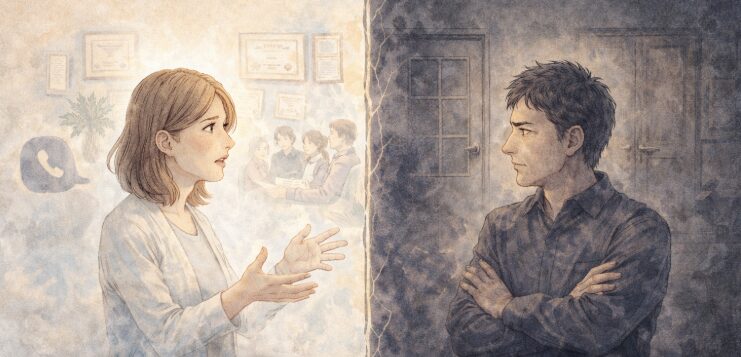
For a survivor of abuse, the word “parent” carries a meaning entirely different from what people raised by ordinary parents know. To them, the parent was not the source of safety. The parent was the source of fear. They lived in a world where the public assumption “parents and children understand each other” simply does not apply.
And yet, most of the world goes on talking to abuse survivors with that very assumption baked in.


Comments