When you hear “intellectual disability (intellectual developmental disorder),” what kind of person comes to mind first?
The image most people hold is probably this:
- People with delays in language understanding or speech
- People with delays in learning — reading and writing, memorization, telling time, handling money
- People who need support or care in many parts of daily life
If you don’t work in welfare, you don’t often meet people with intellectual disabilities in everyday life. When you spot someone now and again on the street or in a station, you offer help if they seem to need it; otherwise, you simply leave them be.
That is probably the picture that comes to most people’s minds.
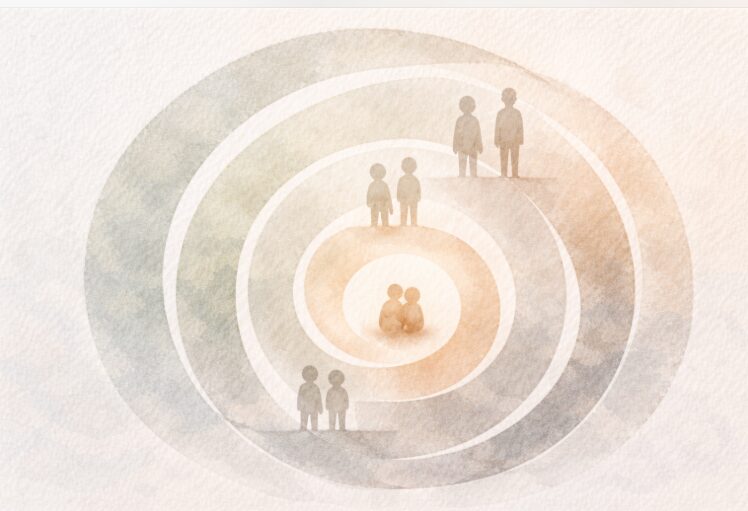
This image is not wrong. But it captures only one corner of intellectual disability.
Chapter 1 — The “Outer Edge” of Intellectual Disability That Most People Never See
What an ordinary person can usually pick up — “this person may have an intellectual disability” — applies mainly to people with moderate (around IQ 50) or severe (around IQ 35) impairment. From the way they look, hold eye contact, and speak, a short interaction is usually enough.
Moderate and severe impairment is, in most cases, noticed by the people around the child during infancy or early childhood itself. Delayed speech, difficulty becoming independent in eating or toileting, awkwardness in communication — these things surface naturally in everyday life.
Even into adulthood, conversation in the moderate range stays markedly simpler than for same-age peers, and learning ability generally tops out around the level of the lower elementary grades. In the severe and profound ranges, concepts such as numbers, time, and money are difficult to grasp, and assistance or supervision is needed for nearly every part of daily life.
After diagnosis, these people generally live inside protective environments: residential facilities, special education schools, sheltered workshops. Support workers are always nearby, and the environment is shaped to fit the person’s range of ability. As a result, social trouble is less likely to arise, and these cases tend not to come up as problems in welfare or medical settings either.
They are “high-needs,” but they are also “visible to society.” The social system, to a real degree, holds them. When a problem comes up, the safety net catches it, and a response follows.
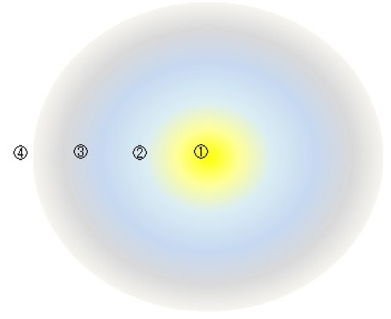
The territory that becomes a problem, then, is not moderate or severe intellectual disability. It lies further out.
There is a category called mild intellectual disability (IQ 50–69). Given that “moderate” and “severe” exist, “mild” naturally exists too — but it falls cleanly outside most people’s mental image.
There is also a layer called borderline intelligence (IQ 70–85). Going one point above the IQ 70 threshold for “mild ID” does not, of course, flip a person suddenly into “normal.” On reflection, a gradient is only natural — and yet this layer, too, is easily overlooked.
The table below summarizes the IQ-based categories, the share each one occupies within the population of people with intellectual disability, and the share within the general population.
| Category | IQ Range | Share within ID population | Share within general population |
|---|---|---|---|
| Profound | ~19 | ~1–2% | under 0.05% |
| Severe | 20–34 | ~3–4% | under 0.1% |
| Moderate | 35–49 | ~10% | ~0.3% |
| Mild ID | 50–69 | ~85% | ~2% |
| Borderline (the gray zone) | 70–85 | by definition, not included | ~14% |
Moderate, severe, and profound combined still come to only around 15% of the ID population. Mild ID (IQ 50–69) accounts for about 85% of all intellectual disability — meaning the majority of people in the “people with intellectual disability” population fall into the mild category. Borderline intelligence is even larger, sitting as a continuous extension above mild ID and accounting for about 14% of the general population. That is more than five times the size of the entire ID population (which sits at about 2–3%).
“Why They Get Overlooked”
As noted, the combined number of people with mild ID and borderline intelligence is by no means small. They show up at a frequency where it would be unsurprising to find them among one’s colleagues, neighbors, or extended family. So why does society fail to notice them? There are two main reasons.
The first is that the concepts of “mild intellectual disability” and “borderline intelligence” themselves are not widely known. For the general public, much of the image of intellectual disability comes from drama and film. But the “person with intellectual disability” who appears in those works is almost always written and staged around moderate-or-greater impairment.
Works dealing with autism have been on the rise, but works that take mild intellectual disability head-on are rarely seen. So very few people — outside those who have a family member affected or who work in welfare — have an accurate sense of what “mild” or “borderline” actually refers to.
The second reason — and the more fundamental one — is that, on the surface, their daily life looks “normal.” They can read and write. They can take a familiar train route alone. They can manage household tasks and work, as long as the tasks are simple. Conversation flows naturally.
Medically classified as “mild,” they are indeed mild compared with people with moderate-or-greater impairment who require ongoing care. In terms of how urgently care is needed, the “mild” label is accurate.
With borderline intelligence, the range of “things they can do” widens further. At a government window, in a clinic, they get treated as “ordinary people.”
But “looking normal” and “being able to do things normally” are not the same thing. And while the support they need fails to reach them, difficulty quietly accumulates.
Chapter 2 — When the “Child Who Was Bad at Schoolwork” Grows Up
People with mild intellectual disability tend to make a first impression of being quiet and reserved. They do not volunteer much. They speak comfortably with familiar people, but rarely with others. They often come across as passive and easygoing.
Mild intellectual disability runs at about 2% of the population — give or take, roughly one student per school class. Their cognitive difficulty tends to surface less in reading, writing, or daily-life skills, and more in interpersonal relationships and the reading of social life.
The line between what they can do and what they cannot lies between “tasks that follow a clear procedure” and “social intelligence.” They handle reading and writing, and routine household or work tasks with set procedures. But reading another person’s intent, judging “what one ought to do here” from the feel of a room, picking up subtle shifts in a relationship — those operations sit in territory their cognition does not reliably reach.
A scene like this: a man at work, told to “respond flexibly,” repeats the same mistake. When his supervisor asks why, he says, “I did exactly what I was told.” That the phrase “flexibly” was meant to say “read the situation and decide for yourself” never reached him. The fact that the single word bundled together a whole “reading-the-room” operation never came into view.
Such people are often seen as “easy marks.” Behind “trusts easily” sits “cannot construct grounds for doubt.” To detect whether someone’s words have a hidden side, you have to run several loops of “why is this person saying this?” “is this really true?” When that processing has limits, predatory pitches and unfair contract terms slip past unnoticed.
The “looking normal” part stays preserved, while the abilities needed to live among other people — “reading another’s feelings,” “judging the situation” — are quietly constrained.
When this profile goes unidentified into adulthood, the person ends up being mistaken — again and again — for “depression,” “personality disorder,” or “schizophrenia.” Even when a diagnosis is given, it is often the wrong label, and a not-small number of cases never connect to support at all.
With luck, mild intellectual disability gets noticed after the start of elementary school, and a diagnosis follows. But many cases reach adulthood without anyone ever identifying the cognitive profile. At school, they get filed under “kids who aren’t good at schoolwork.” Once they enter society, they are treated as “people who are bad at handling things.” Neither the person nor the people around them recognize this as a feature of cognitive ability.
As a result, workplace trouble, interpersonal difficulty, and social maladaptation accumulate — without the person ever being recognized as someone whose constraints call for support.
Chapter 3 — The 14% Placed Outside the System: People with “Borderline Intelligence”
If even mild intellectual disability is overlooked, the layer one step further out — borderline intelligence (IQ 70–85) — is even more invisible. They are not classified as “people with a disability.” They cannot receive a disability certificate (techō). They are not the target of welfare services. They are placed on the “outside” of the welfare system.
Yet they make up about 14% of the population. Roughly one in seven — a sizable number that includes our colleagues, our classmates, the people in our workplaces.
The cognitive difficulty that people with borderline intelligence carry is lighter, in degree, than mild ID. But the kinds of difficulty are similar in shape. Reading another’s intentions, organizing complex information, planning ahead — these are all areas where subtle but real constraints are present. They can manage, but always at a hidden cost.
“Looking Normal” Pushes Support Away
Because they “look normal,” it is hard for the people around them to imagine that any constraint is at play. The person themselves often does not understand why they are having such a hard time. It tends to get filed inside the framework of personality: “lazy,” “selfish,” “irresponsible.”
At the hospital, at the government window, at the workplace — the response is, “well, you can manage on your own.” The fact that they sit at the edge of “being able to manage,” paying a hidden cost again and again, is invisible to others.
At school, in society, they are placed alongside the average and asked to keep up. The exhaustion of always trailing a step or two behind is something only the person themselves carries.
Summary
Here is a summary of the main features of both groups, as we have seen them.
| Comparison | Mild Intellectual Disability (IQ 50–69) | Borderline Intelligence (IQ 70–85) |
|---|---|---|
| IQ range | 50–69 | 70–85 |
| Official recognition | Eligible for a disability certificate (ryōiku-techō) | Outside the system (the gap in support) |
| First impression | Quiet, reserved. Looks “normal” at a glance. | May even look “competent.” |
| Daily-life ability | Can handle procedural tasks, but has difficulty with complex judgment and interpersonal situations | Looks self-sufficient on the surface |
| School / employment | Belongs in special education ideally, but often sits in regular classrooms | Stays in regular classrooms while carrying invisible difficulty |
| How easily noticed | Less noticeable than moderate / severe, but sometimes identified around the start of school | Often goes unnoticed, even by the person themselves, into adulthood |
Where do these difficulties — invisible at first glance — actually show up? Not in the predictable places — “can’t do math” or “can’t read.” They lie in territory far harder to spot. The next article walks through the “surprising difficulties” and the “difficulties that don’t look like they come from a disability” in concrete scenes.











Comments