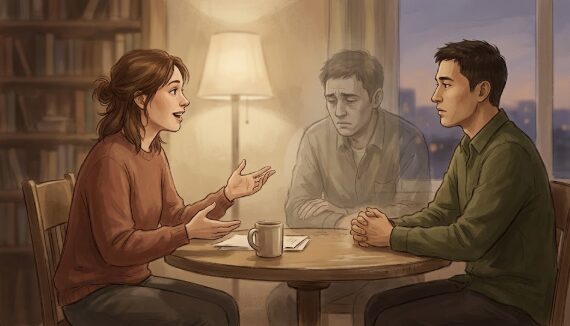
Shiori (a pseudonym, 30) sat in the counseling room of a clinic in Tokyo.
She had worked as a care worker; now she was on leave. The medical certificate that read “depression” was the second one of her life.
It was her sixth session. After a long, heavy silence, the words finally broke through.
What she was bringing today was a report from inside the rubble — her world had collapsed in the previous session, and was now being rebuilt from the wreckage of one new fact.
Chapter 1: A “Diagnosis” That Hit Like Blunt Force
“Last time, you said it, didn’t you. ‘There is a strong chance your mother has mild intellectual disability.'”
Her voice trembled.
“At that moment, I think I just said ‘oh, really’ calmly. But honestly… it was like being hit on the head with a blunt object. My mind went white. I was struggling just to grasp the meaning of the words.”
— My mother has an intellectual disability. The thought had never once crossed her mind.
Her mother had lived a normal life. She did the shopping, worked part-time. It was just that conversations didn’t quite line up. Explaining something repeatedly didn’t help. She would explode emotionally out of nowhere. Shiori had registered all of these “off” moments as “my mother’s personality.”
Chapter 2: Memories Replay; the Real Picture Comes Out
That single fact changed everything Shiori had ever known about her own life. The pieces of childhood that had never made sense suddenly clicked into place.
The way her mother got irrationally angry over small things. The way her praise never landed where Shiori expected. The way her mother seemed bewildered by even simple emotional exchanges. None of it had been “Shiori being bad.” Shiori had been a child trying to do her best inside a system that simply could not run.
In middle school, when Shiori brought home a perfect test score, her mother didn’t praise her. She gave a puzzled look and said, “Hmm. Anyway, what’s for dinner?”
“I’m being punished for not helping enough at home, for letting myself get carried away with a test.” She threw the test in the trash and headed to the kitchen.
“My mother hates me. I am defective. That’s why I’m not loved.” From a very young age, Shiori had believed exactly that. If she could change, if she could try harder, her mother would one day turn toward her.
But everything she did backfired. Things done with good intent were yelled at. Caution earned silence.
“But… there was no reason.”
Large tears fell from her eyes.
“It wasn’t that I was bad. It wasn’t that I was abnormal. … It was just that my mother was a person who didn’t have the spec to be a parent.”
It was a brutal kind of relief. Her own innocence was finally proven. At the same time, the future she had been holding onto — the hope that “if I try hard enough, she’ll love me” — was completely cut off.
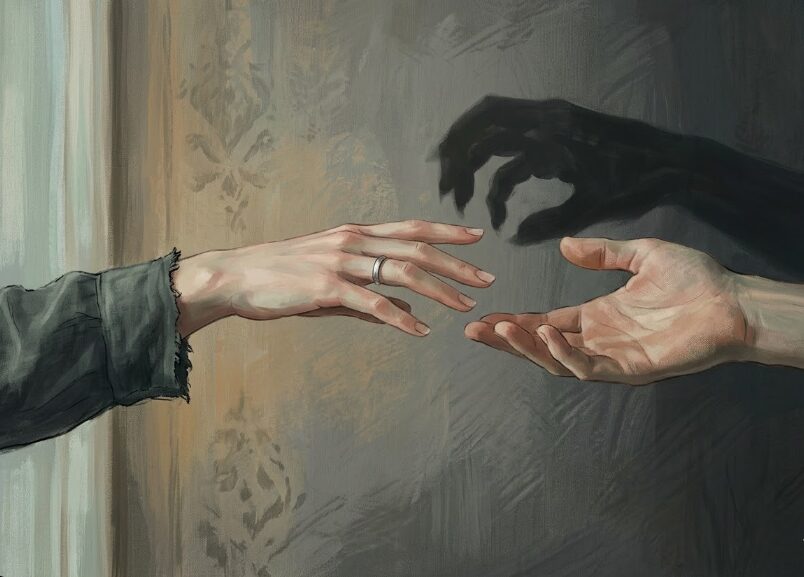
This is the psychological state called “ambiguous loss.” The parent is alive, present, exists physically — and yet has never been an “emotionally available parent.” A grief without funeral, a loss without resolution.
Chapter 3: The “Normal Mom” She Wanted
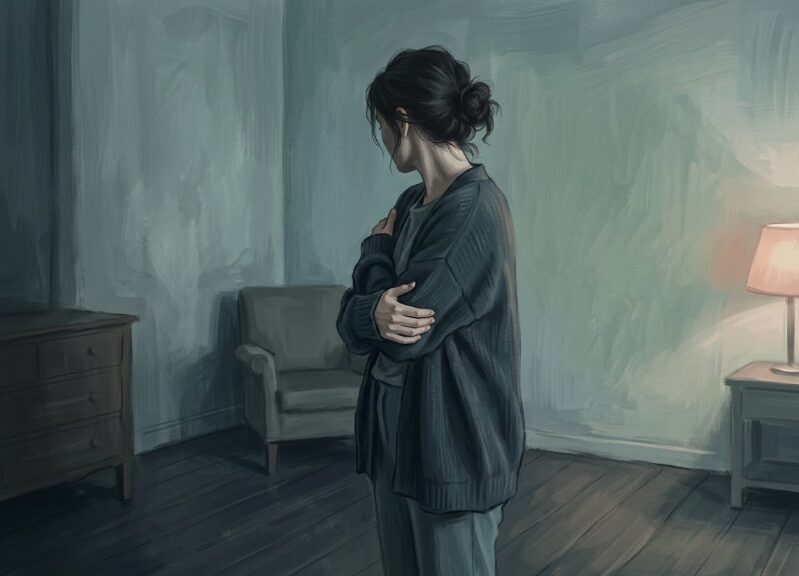
“I was scared, the whole time.”
The fear of words not getting through. Speaking the same Japanese as another person, and yet feeling she was facing an alien — an absolute disconnection. Whatever she threw, it came back from an unexpected angle, or wasn’t even recognized as a ball at all. The exhausting futility of that.
This sense of “not getting through” is one of the deepest forms of suffering shared by children raised by parents with mild intellectual disability. The experience of “I cannot reach a person who, by all rights, should understand my words” rocks the child’s sense of their own existence at the foundation. The isolation of seeming to become invisible plays out, over and over, in everyday moments.
“I wanted a normal mom.”
Shiori cried like a child.
“She didn’t have to do anything special. I just wanted her to hold my hand. To say, ‘that hurt, didn’t it.’ To smile and say, ‘wow, that’s amazing.’ To see me as a single human being.”
I wanted to be a normal kid. Not a translator filling in my parent’s words, not a caretaker managing her mood — just a child who was protected and loved.
Chapter 4: You Are a “Survivor”
“You don’t have a developmental disorder. You have unusually high intelligence and rich sensitivity. If you’d had the same kind of impairment as your mother, you wouldn’t be suffering this much. It’s exactly because you are ‘normal’ that you couldn’t adapt to that abnormal environment — an environment a human child should not have had to grow up in — and have suffered as a result.”
This sounds paradoxical, but it is an important point. When a cognitively typical child grows up under a parent with intellectual disability, the child gets stuck in the doubt “is something wrong with me?” — because every other family around them appears to function “normally,” and only their own home doesn’t. The child cannot reach the thought “the problem is in my parent’s cognitive ability.” So the only available conclusion is “the problem is in me.”
Shiori looked up.
“In your family, there was no ‘adult’ capable of raising you. Not a single guardian. No one whose feelings could connect with yours. That is no different from a baby being dropped, alone, into a jungle.”
“You grew up alone, and no one ever noticed your loneliness. You read your parent’s mood, kept the household running, killed your own feelings, and survived with everything you had. You didn’t even have the bandwidth to register that you were enduring, that you were tense, that you were afraid.”
The counselor looked her straight in the eyes.
“For a small child, that is a tremendous fear, and a brutal form of abuse. You can rightly be called the survivor of that battlefield — the one who came through it alone.”


Comments