Koji (a pseudonym), now a first-year middle school student, lives with his calm adoptive parents.
He goes to school, throws himself into club activities, and chats with his adoptive mother over dinner about nothing in particular. The path he had to walk to arrive at “an ordinary daily life” was extraordinarily harsh — and extraordinarily quiet.
He was separated from his biological parents and taken into protection at age three. The reason: severe weakening from neglect.
What sets Koji’s case decisively apart from other abuse cases is that there was no clear malice anywhere in it.
Chapter 1: Diligent Workers, Dysfunctional Parents
Koji’s biological parents were, by no means, “lazy.” Both worked at the same factory. Neither ever skipped a shift, and at work they were known as “serious, quiet people.”
But what they lacked sat at a level beneath “the ability to parent” — they lacked the ability to maintain a household at all.
Their living space, the moment you opened the door, gave off a strong smell. It was a hoarder’s home. Koji was being raised inside that mountain of garbage, never sent to a daycare.
Each morning, before leaving for work, the parents prepared his “three meals for the day.” Convenience-store rice balls, bread, and snacks lined up on the floor. They left the house without checking whether the food was actually edible. Whether the small body in the room had drunk water. Whether he had been changed.
Chapter 2: A Closed-Off World
One stretch — based on what was later reconstructed — Koji was apparently left alone in the apartment for nearly a week.
The parents had gone, in their own words, “somewhere where it felt easier to be.” They were not running away from him. They simply did not register that “leaving a three-year-old alone for a week” was a thing that would kill him.
Chapter 3: A Life Left Behind
It was a neighbor who noticed. “There’s a strange smell.” The landlord, called in, opened the lock — and inside was hell. In a pile of garbage and waste, a small body so weakened it was hard to tell whether it was breathing was curled up.
The parents were arrested when they got home. Under questioning by police, they showed no remorse. They were merely confused, and gave statements like:
“There was a feeling of not wanting to come home.” “He was three, so we figured he’d be okay.”
The public reacted with horror. “Beasts.” “Devils.” But the specialists who came in saw something else.
These two were almost certainly in the band of “borderline intelligence (IQ 70–85)” or mild intellectual disability — a band where complex chains of cause and effect cannot be held in mind. They could not project the future “leave a three-year-old alone for a week and he will die.” They could not anticipate that “a large pile of food will rot.”
To them, Koji was, cognitively, much like a houseplant — give it water and fertilizer and it grows by itself.
Koji had severe dehydration and food poisoning. The doctor said one more day and there would have been no life to save. The other shock was his language ability. At age three, he could speak only four or five words.
Cut off from human contact, fed only as one might feed an animal, his brain’s development had been profoundly stalled.
Chapter 4: Re-Growth, and Looking Back
After a child welfare facility, Koji was taken in by his current adoptive parents. Special adoption. The new family taught him “words” and “world.”
“This is an apple.” “The sky is blue today.” Showered with affection and language, his brain absorbed it like a dry sponge taking in water. In about a year and a half, he could hold a conversation almost indistinguishable from any other child his age.
He knows he was not “thrown away.” And as he grew, he came to understand that his biological parents had not been “ordinary adults.”
Looking back from middle school, Koji puts it this way:
“I think Dad and Mom were trying their hardest.”
There is no resentment, no hatred in the words. He receives it as a quiet fact.
“They left lunches for me, and when they came home they played with me. I think, in their own way, they loved me. They just didn’t know how.”
Chapter 5: When a “Painful Memory” Becomes “Proof of Survival”
The memory of abuse exists, for a long time, as “the painful thing.” Wanting not to remember it — wanting, if possible, to erase it — is a natural response. But for some who have gone through trauma treatment, the same memory eventually starts to look like “the proof that I, against the odds, was still alive.”
Many people with experiences like Koji’s carry “dissociation.” This shutting-down of feeling under extreme conditions is not something that “just happens.” It is what the mind actively chose, after the very early lesson, repeated, that “if I keep feeling this, I cannot continue to live.” By not feeling, the child managed, barely, to keep going.
Trauma treatments such as Somatic Experiencing (SE) and EMDR work by making safe, gradual contact with the memory written into the body and processing it. Within that process, the “quality” of flashbacks sometimes shifts. The same memory stops being experienced as suffering. It becomes a memory without pain.
This is not “forgetting.” The memory is still there. But when the person looks at it now, what comes into view is “the version of me that, even inside that situation, was still alive.” When the way you regard your past self changes, the way you regard your current self changes too.
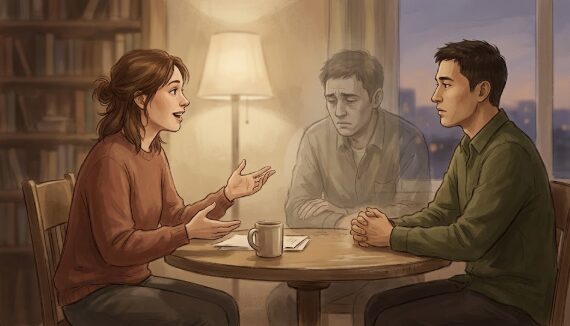
The moment Koji felt “I can finally see my father as a regular person” may be one form of that same shift. When the object of fear stops being “a monster” and becomes “a person who was simply unable to perform a parent’s role,” the perceiver — Koji himself — has stepped into a different place.



Comments