In the middle of recovery, words like these sometimes come unbidden: “I have been living distorted, the whole time.”
It is not that the person had been lying. It is also not exactly that they were intentionally fooling themselves. So what does “living distorted” actually mean?
1. What “Living Distorted” Means
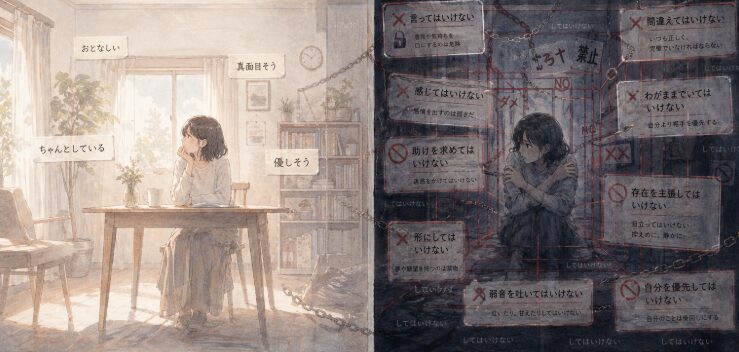
What is the “distortion”? The facts don’t disappear. What slips out of alignment with reality is the meaning attached to those facts. That is the distortion.
Yelled at. Hit. Ignored. The events themselves stay in memory. What changes is how the events are received. “Yelled at” becomes “she’s worried about me.” “Hit” becomes “I did something bad.” A gap opens between fact and meaning.
Why does this happen?
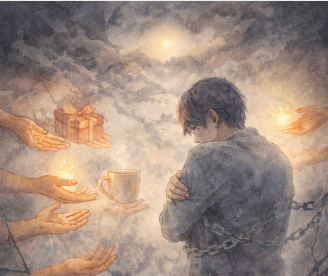
A child who loves their parent purely and quite reasonably hopes to be loved in return will eat the apple even when the apple is poisoned. They mistake the curse for love and accept it. Sometimes they even hold it close.
For a small child wired to love their parent, stopping that love is close to impossible. So instead of “drinking the poison knowing it is poison,” the child does “drinking the poison interpreting it as love.” That gap in interpretation becomes the distortion, and the distortion deepens across the years that follow. That is what “living distorted” is.
The distortion does not arrive complete. The parent lays the foundation; encounters with the outside world introduce contradictions; in trying to dissolve those contradictions, the distortion deepens, layer by layer. Below, that progression is traced.
2. The “Rare Kindness” That Holds the Distortion in Place
Even after a child glimpses the outside world, there is another reason they cannot reach the conclusion “my mother does not love me.”
Because somewhere in their memory, however rare, there is a moment of “Mom was kind.”
Look at one of these brief moments of kindness.
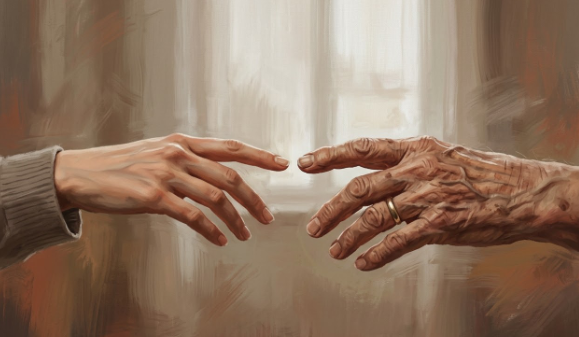
Bumping into the mother in the entryway, the mother in passing reaches out and, for one second, touches the child’s head. Without turning around, she walks out the door. In that instant the child thinks, “Mom does love me, after all.” For that moment, every shouting match goes silent.
That memory becomes the line that reconciles everything. The violence and the silence get filed away as “exceptions”; only the second of kindness stays as “Mom’s true self.”
Within the daily yelling and severity, occasional flashes of “being loved” appear. A smile. An unexpectedly soft word. The child takes a deep breath and feels it: “Mom does love me, after all.”
Behavioral psychology has long known that intermittent reinforcement — a reward that comes only sometimes — embeds a behavior more strongly than a reward that arrives every time. That is why slot machines are hard to stop playing. The “occasional kindness” inside an abusive home has the same structure. Precisely because the everyday is harsh, a single moment of softness is engraved as a treasure. With that memory as anchor, the child keeps the belief “she does love me” alive.
3. The Rewriting Continues into Adulthood
The rewriting of the parent does not end with childhood
As a child, the survivor did not have the capacity to take in head-on what kind of place their home actually was. Somewhere inside, there was a faint sense of “ours is different.” But it could not be admitted. They thought, “Once I’m an adult I’ll be able to look at this properly.”
Sometimes that does not happen.
Look at one such moment — running into a former classmate at a part-time job.
The conversation drifts; the classmate says, mid-thought:
“Your mother always seemed like she’d be a lot to deal with. Are you living separately from her now?”
What came out of the survivor’s mouth, faster than thought:
“Huh? She’s a normal mother.” The “rewriting” of the parent has become so automatic that even years after the relevant childhood, even on a side conversation, the answer arrives before the truth has any chance to.
4. The Phases of Distortion
Stepping back, the “shape of distortion” can be sorted by stage.
| Stage | What’s happening | What the child does |
|---|---|---|
| Pre-phase: laying the foundation | Inside the home, harshness and rare softness alternate | The child hangs everything on the rare softness, feels “I am loved” |
| Turning point | Glimpses other families. The sense “ours is different” arises | Stops just short of the conclusion “my parent is the problem.” The recognition gets quietly tucked away |
| Phase 1, opening: rewriting begins | The contradiction is dissolved by giving the “rare kindness” weight | Receives the poison as love. Defends the belief “she loves me, of course she does” |
| Phase 1, core: distortion deepens | The rewriting becomes the default mode of seeing | The harshness is treated as exception; the kindness as essence |
| Phase 2, adulthood: the rewriting continues | Even when an outsider names what was happening, the rewritten version comes out first | “She’s a normal mother” leaves the mouth before thought; the survivor doesn’t notice they’ve said it |
5. Toward Undoing the Distortion
The distortion is not stupidity. It is the only way a small child could keep loving the parent they had to keep loving in order to live. To dissolve it requires not blame but a slow re-pairing of fact and meaning, inside a relationship safe enough that the survivor can let the rewriting fail without anything terrible happening.
“There were yelling and hitting and silence — and there were also occasional moments of softness — and those second-long softnesses were not ‘who Mom really was.’ They were briefly nicer moments inside an environment that was, on the whole, abusive.” When the distortion can finally be set down, the survivor doesn’t lose anything real about the past. They get back the right to read the past honestly.





Comments