“It Happens in Any Home,” “You’ll Repeat It” — Two Common Beliefs
If you have ever told someone about what your parent did to you, you may have been met with words like these.
“Every family has its share of that, more or less.”
“Parents are only human—no one is perfect.”
“You should be grateful you were raised at all.”
“You’ll understand once you become a parent yourself.”
Even turning to professionals brought much the same response. “Your mother had no room to breathe, either.” “I’m sure she regrets it now.” In worse cases, there was a warning: “Be careful not to repeat the same thing with your own child.” None of these words answer what survivors most want to know.
Beneath these professional responses lie two beliefs that run wide through society.
One: “Abuse can happen in any home.”
The other: “People who were abused become more likely to abuse their own children—the cycle repeats.”
These are also the “official language,” repeated in government handbooks and public-awareness campaigns.
Why was my parent the way they were? And why couldn’t even the professionals explain that “why”?
To trace that “why,” let us look back over sixty years of abuse research.
The Four “Causes” Experts Kept Searching For
Abuse was “discovered” as a social problem more recently than you might think.
In 1962, an American pediatrician published a report on “battered child syndrome.” It drew on more than seventy medical institutions across the United States and around three hundred cases. More than half of the victims were under four years old, and over one in ten had died. There were bruises, bleeding inside the head, old and new fractures layered together—and the account the parents gave did not match the medical findings. It was the moment society finally acknowledged that behind children’s unexplained deaths and injuries, long overlooked, lay violence by their own parents.
But the same discovery spread a single phrase: “Abuse can happen in any home.” At the very starting point, everything was set slightly askew.
From here, experts set out to find “what kind of parent abuses,” mainly along four lines.
- The parent’s personality and emotional tendencies. Dependent, impulsive, immature, placing excessive expectations on the child. Feeling hit or insulted, they would retaliate, treating an infant as if it were an equal adult. Some researchers noted that such parents felt, “I am the one being victimized by my child.”
- Mental illness. Yet what correlated most strongly was low mood—depression; serious conditions like schizophrenia were, if anything, rare, under ten percent.
- Life circumstances. Isolation, poverty, unemployment, marital discord, and the “child who is hard to raise.”
- The parent’s own history of being abused as a child—the so-called “cycle.”
But one thing troubled researchers for a long time. Not one of these four turned out to be the deciding factor that guaranteed abuse. Not every parent with a difficult temperament abuses, and not every poor household does either.
So why did no deciding factor emerge? In truth, one possibility had been left off the list from the very beginning.
The Root That Was Overlooked
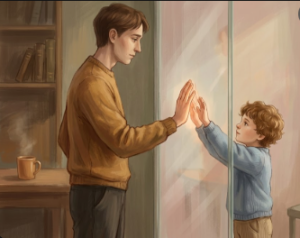
What had been left off was the case in which the parent themselves has, from birth, real difficulty reading a child’s heart.
Sensing that a child is hungry. Noticing a face that looks cold. Guessing why a child is crying. This work of putting yourself in another’s place and reading their heart calls on a demanding mental capacity—one apart from reading, writing, or housework. When that capacity is impaired from the start, no matter how much the parent loves the child, their feelings never quite connect.
Just as some people are born with weaker eyesight, the ability to read others’ feelings, too, varies from birth.
In fact, realizing that a parent carried this difficulty can become a turning point for the child.
For a long time, I believed my parent acted that way because I was a bad child. But when I understood that my mother had, from the very start, great difficulty reading people’s feelings and managing the practical tasks of daily life, I finally began to be freed from the guilt and shame I had carried since childhood.
The detail of this “ability to read a heart”—exactly what becomes difficult, why it is so hard for others to see, and how it can lead to abuse—is covered in depth in a separate set of articles.


What this article wants to pause on is not that detail itself, but rather why such a large root went overlooked for so long.
Strangely, research that examined this root directly is so scarce it is hard to find even going back through the decades. One old study reported that “about half of the parents who abused scored low on intelligence tests,” but the line of inquiry never grew from there.
Japan’s guidelines are no different. The thick national handbook (Japan’s official manual for responding to child abuse) runs to some six hundred pages, yet it touches on this parental difficulty in only a handful of places—fewer than ten lines—and most of those describe the child’s disability, not the parent’s. Even in the official handbook, a parent’s intellectual difficulty appears only as one item among many—”mental illness, dependency, and so on”—and is taken no further. In other words, this possibility on the parent’s side is all but absent from the official guidance.
Meanwhile, professionals with long field experience say that a sizable share of abuse involves this “difficulty within the parent.” The single most easily overlooked factor has dropped clean out of both the research and the guidelines.
“Risk Factors” May Be Results, Not Causes
What was lined up while this root went overlooked are the so-called “risk factors.”
Because no single deciding factor could be pinned down, the prevailing view in recent years became that abuse occurs when several risk factors overlap. The national handbook takes this position too, stating that abuse “arises from a complex interplay of many factors,” and lists factors like these.
- The parent received no affection from adults in their own childhood
- The stresses of life—money worries, marital discord, the burden of child-rearing—have piled up
- The family is socially isolated, with no one to help
- The child is one the parent finds “not as they wished”
At first glance this seems reasonable. But there is a trap here. Many of these “risk factors” may be not causes but results.
Imagine, for example, one mother. From early on, she found it hard to read people’s feelings from their faces, or to plan and carry tasks through in order. At work, she keeps missing her colleagues’ intentions, and no job lasts long. Her income never steadies, and life grows harder year by year. She drifts away from the neighbors, never sure what to say, until there is no one left to turn to. When her child cries, she cannot tell why, and is left at a loss.
Someone looking at this household from the outside would write it down as “poverty,” “isolation,” “a difficult child”—three fine risk factors, all in a row. And yet all three grew like branches out of one difficulty she had carried from the start: the difficulty of reading hearts and managing the practical tasks of daily life.
Make no mistake: this is not a way of erasing the parent’s responsibility. Quite the opposite. Precisely because such circumstances get filed away under the phrase “it can happen in any home,” the real cause is left untouched. Tracing where the belief comes from is the first step toward finally reaching that cause.
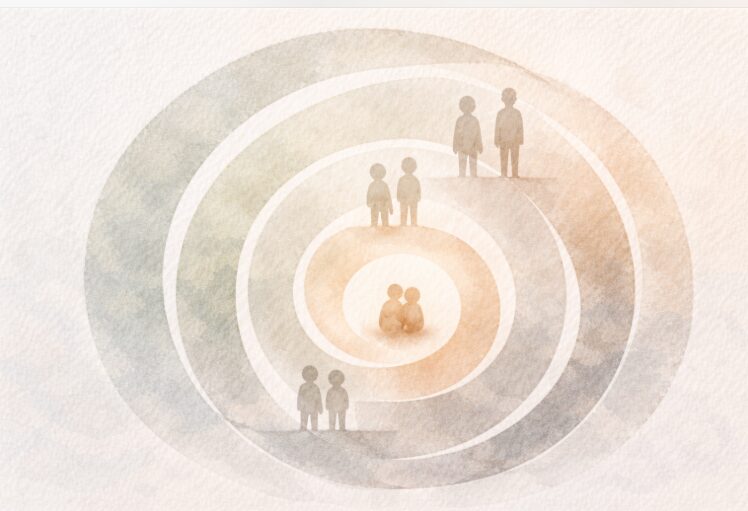
In short, branches growing from a single root have been lined up side by side and called “the causes.” Cause and effect are placed on the same level, so the real root stays forever out of reach. You can prune the branches—”let’s reduce isolation,” “let’s offer financial support”—but as long as the root remains, another branch simply grows.
And where this confusion shows most clearly is in the most famous belief of all—the cycle.
What the “Cycle” Really Is — Continued in the Next Articles
“The parent was abused in their own childhood.” This cycle, too, is a well-known belief, standing alongside “it happens in any home.”
It rests on the same confusion. What looks like the experience of being abused passing from parent to child was, in truth, something else being handed down—the parent’s own difficulty in reading hearts. That is the view now emerging.
How the figure for the cycle was overturned—from the “ninety percent” once claimed down to “about thirty percent”—and what that thirty percent really turned out to be: these go a step deeper, so we leave them to the two articles that follow.

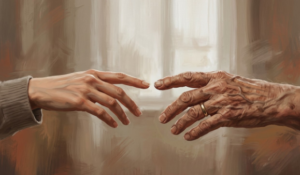
The one thing to hold onto here is just this: “the cycle repeats” and “it happens in any home” are two beliefs born from one and the same confusion.
In Closing
“It happens in any home.” “Any parent, pushed far enough, might do it.” “You, too, someday, to your own child.”
These words look unrelated, but they share a single root. Over sixty years, experts kept the real cause off the list and mistook effects for causes. From that same distortion, belief after belief branched out.
If that “why” never came back to people who grew up abused, it was not because their question was misguided. It was simply that the side searching for causes had never been looking in the right place.




Comments