Many people who were abused as children do not realize what happened to them, either at the time or for decades afterward.
One survivor reflects: “The very perspective from which I could have noticed something was wrong simply wasn’t there in me.” Another says: “It never once crossed my mind that the family I had been with since birth could be abusing me.”
If someone hits you on the street, you know you have been hit. If someone steals from you, you know you have been robbed. Harm is normally recognized as harm. With abuse, this does not happen so easily. Even when struck or verbally torn down, the person does not register themselves as a victim. This article explores why.
Four Scenes Where the Abuse Goes Unrecognized
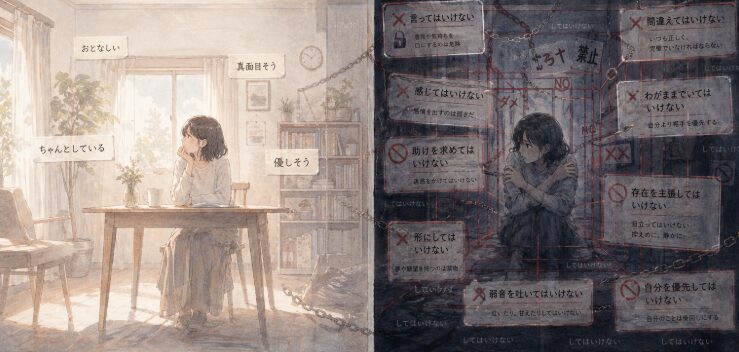
Abuse is not always the dramatic, visibly cruel form portrayed on television. From the outside, a family may look exemplary — distinguished parents and bright, capable children. According to Japan’s child guidance centers, the most common form of reported abuse is psychological abuse, accounting for roughly 60 percent of all cases. Psychological abuse leaves no physical trace, and yet it heads the list.
What lies hidden inside the home includes, for example:
- harsh language
- lack of empathy from the parent
- overprotection and overinvolvement
- backbiting and disparagement
What follows is four scenes in which the abuse went unrecognized.
The Overinvolved Household
Consider a household in which the parents’ involvement saturates every part of daily life.
A child grew up with a father devoted to his work and a stay-at-home mother. The father held a respected position locally; from the outside, the family looked unassailable.
The child knew, from a grandmother’s words, that the parents had endured years of fertility treatment before finally conceiving. A child wanted so deeply, who had to be loved so much — this conviction became the soil in which every subsequent intrusion took root as “concern.”
Curfew was six in the evening. It stayed six even in high school, even in college. Reporting back to her by phone from anywhere outside became the expected thing. When friends were mentioned, the mother wanted to know about their families too. Career choices were guided not by the child’s wishes but by the parents’.
The child did not see this as overinvolvement. “She’s just worrying about me,” was how the child took it.
Mother-to-Son Sexual Abuse
Hard-to-recognize abuse is not limited to psychological forms. Sexual abuse, too, has variants that are rarely identified by their victims.
When the public hears “sexual abuse,” the image that surfaces is usually a father and a daughter. Mother-to-son sexual abuse falls outside that prototype, and so it becomes even harder for the victim — or anyone around — to recognize what is happening.
Consider the following scene between a mother and her son.
He was an only child. His single mother had raised him with her undivided attention. The sense of having been cherished was vivid.
They had shared a bath together for years. He had seen her body; he had occasionally touched it. They had washed each other. She had instructed him in masturbation.
The part about masturbation he could not bring himself to tell anyone, but he once mentioned the shared baths to a friend, and the friend said, “That’s not normal.” His first reaction was bewilderment — what was odd about it? Being told he himself was strange felt unfair. To him and his mother, all of it had been simply ordinary. The thought that it might be abnormal had never entered his mind.
“Sexual abuse,” as the world used the term, meant a father reaching for a daughter. He and his mother could not belong to that category. It was as if the very word “abuse” had never been in the room.
An Attack Framed as “For Your Own Good”
Even when a clear attack does happen, it can be received as the victim’s own fault.
The mother ignoring her, snapping at her over trifles — the real reason was beyond comprehension, but the child had no sense of being abused.
She believed she herself was the cause of the mother’s anger. The mother must still be angry about something the child had done long ago, she thought; being ignored, being yelled at, was therefore deserved.
The following day the father would say, “If you don’t like it, say something back instead of staying silent,” and this only deepened the conviction that the fault was hers. The father was simply letting the mother’s verbal assaults pass without intervening, but the child took his words as concern for her welfare.
Or this kind of scene.
The child spilled food at school lunch and stained her clothes badly. She came home and apologized to her mother.
Without a word, the mother went into the child’s room and, one by one, tore each card in half, one by one, from the collection the child had spent years building.
The tears would not stop. The mother said, “You don’t take care of your things, so Mama is teaching you a lesson.”
The child said nothing.
“I Could Have Really Killed You — Be Grateful”
Conversely, even abuse that any outsider would immediately call severe can fail to register as such for the person inside it. Beaten, kicked, screamed at — if it is “ordinary” in the household, it does not surface as victimization.
Unrecognized abuse is not light abuse. Whether or not it is recognized has nothing to do with severity; it is decided by the relationship between the person and the household they grew up in.
In first grade, he was kicked hard enough that his body flew from one wall of the room to the other. Even then, he did not think he was being abused.
Each time he was beaten close to senseless, his father would say the same thing: “I could really kill you. I’m holding back this much — be grateful for that. I take the trouble to do this because I need you to understand.”
He took it at face value. He genuinely felt sorry that he had put his father through so much effort. What weighed on him was not the kicking, but his own inadequacy that had forced his father to go that far.
What the Four Scenes Share
The severity of the harm and the victim’s awareness of it do not run together. When the perpetrator persistently frames the harm as “for your sake” or “your fault,” the more violent the act, the more the victim receives it as punishment they deserved — and the path to recognizing it as abuse is closed off.
Even when struck, even when humiliated — why does the person take the attack as their own fault? What is the device that builds this illusion?



Comments