Thank you for stopping by this blog. This article is written for survivors of abuse. Some of what follows may bring up painful feelings, so please read it at a pace that fits your current state. If this is your first visit, please first read the article below.

Many people who grew up with abuse share one particular trait: they live in a way that tries to “not feel anything.”
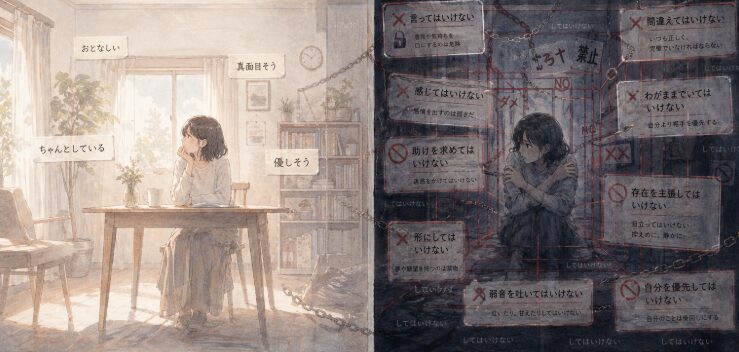
The full range of joy, anger, sadness, and delight is barely visible in their expression. Or, even when emotions appear on the surface, they are only being performed; internally, nothing is being felt. They make no complaints, carry an oddly even tone, and can sometimes look almost robotic.
Why did they have to live with their emotions held down like this? In this article, we explain it through three angles.
Reason ① — Their Parents Never Helped Them Develop Their Feelings or Sensations
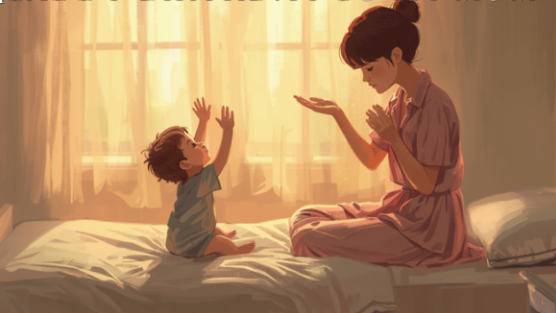
A human baby learns, from their parents, that every feeling and every sensation has a name.
The body is cold — “You’re cold, aren’t you.” The stomach is rumbling — “You’re hungry, aren’t you.” The diaper is dirty and uncomfortable — “That feels bad, doesn’t it.” A loud sound makes the heart race — “That startled you, didn’t it.”
The mother gives names to sensations the child cannot yet put into words. This is “emotional empathy” — the foundation on which the child’s emotions grow.
A child whose feelings have been named in this way eventually becomes able to put their own sensations into words: “Mom, it’s cold today. Could you get out my sweater?” Complex feelings such as joy, sadness, and frustration build on top of the basic sensations that are already in place.
When the Child Grows Up Inside Abuse
But a child raised inside an abusive environment does not have this foundation. Without empathic naming from a parent, the child grows up unable to tell whether what they are feeling is “cold” or “pain,” or whether it is something they should simply endure. They cannot grasp their feelings, and they cannot accept them. As a result, the feelings remain undeveloped and become suppressed.
Reason ② — Showing Emotion Was an Environment That Brought Attacks
“Feelings never developed” is a passive reason — something missing rather than something done. But there is another reason survivors suppress emotion, and it is more urgent: the lived experience that showing emotion at all was dangerous.
When the Child Held a Positive Feeling
Take positive feelings first. The moment a child shows “anticipation” or “looking forward to something,” the abusive parent will not let it pass.
The child saves up allowance for Mother’s Day, manages to buy a handkerchief, and offers it. The instant it is offered, it is thrown to the floor with a sneer: “You think I’d be happy with something this cheap?”
Or, when the family is going out to eat: “You think we’d take you along?”
The moment the parent senses the child is looking forward to something, they make a point of taking it away. The child looks forward to something, is betrayed, falls into despair. After this is repeated again and again, the child learns to treat “looking forward to anything” itself as a dangerous feeling. Don’t hold hope for the future. Always assume the worst. That way, when the betrayal comes, the damage stays as small as possible. This is their survival strategy.
When the Child Showed a Negative Feeling
Now, negative feelings. When a child lets “sadness,” “I don’t want this,” or “this is painful” show on their face, somehow it registers with the abusive parent as “rebellion against the parent.”
“What’s with that attitude?” “You’re doing it on purpose.” “Are you trying to embarrass me?” “There’s no way that hurts.” Each time the child shows a pained expression, more violence is delivered.
So: positive feelings get taken away, and negative feelings draw attacks. Inside an environment where neither kind of feeling can be safely held, the child has only one option: to pretend not to feel anything. When something terrible happens, do not let displeasure show on the face. When something good happens, do not let the expression change. That was the only way to protect themselves.
Reason ③ — Cutting the Heart Off From the Self Was the Only Way to Survive
What Is Dissociation?
Apart from “trying not to show emotion,” there is a more fundamental defensive response.
While being beaten, counting each line of the wood grain on the ceiling, one by one. Being shouted at, but feeling that it was not happening to oneself — as if someone else was being scolded and one was just watching from beside them. Coming back to oneself and finding that time had skipped, unable to remember what had been eaten for lunch that day —
In psychiatry, this more fundamental defensive response is called “dissociation.”
When abuse becomes too brutal to bear, the brain stops experiencing what is happening as “happening to me,” in order to protect the self. As if a separate version of the self has stepped in and taken on the suffering, consciousness recedes and emotion shuts down.
While dissociation is happening, every feeling and sensation goes numb. Memory becomes hazy. Sometimes the person enters a state of watching their own life from outside, as if it were a movie. In psychiatry, this is recognized under names such as “depersonalization” or “dissociative disorder.”
What is important here is that dissociation is not something the child does on purpose. It is more like an “emergency shutdown” the brain triggers automatically. But when this defensive response keeps firing in childhood, the circuit for feeling emotion itself grows weaker over time.
Effects That Appear in Adulthood
Even after they have grown up, when stress hits, the emotion-switch flips off on its own. In moments that ought to bring happiness, nothing stirs. On hearing news that ought to bring sorrow, nothing rises up either. This is not “a cold personality.” It is the defense mechanism built in childhood to stay alive — still operating to this day.
These three reasons do not work in isolation. They overlap, layer on top of each other, and together produce the state of “feeling nothing.” From here, we tie those threads together, then turn to how this same “emotional suppression” is often misread as a developmental disorder.
“Feeling Nothing” Was a Survival Strategy
We have looked at three reasons. The child was not given help in growing their feelings. Showing emotion drew attacks. And cutting the heart off from the self was the only way to bear what was happening.
For a survivor, emotion is, in a sense, a troublesome thing: it makes a hard life even harder. In an abusive household, feelings cannot grow. Even if a feeling does form, it brings more harm than good. Each day, terrible things kept happening. Getting through it by feeling as little as possible, taking as little of it as possible to heart — that was the best survival strategy available.
The next article picks up the thread from here: what challenges remain for someone who has lived this way, and what perspectives support workers need to keep in mind.


The “Quiet, Well-Behaved Child” Is Often the Child in Crisis
“The child who doesn’t cry when they fall.” Children raised in households where abuse is happening often become this kind of child. They do not cry when they fall and hurt themselves. They do not change expression when they are shouted at. Showing emotion was not safe. Crying brought down the parent’s anger. Showing joy was met with mockery — or with being ignored. Fear of showing emotion gradually accumulates inside the body and, in time, becomes “not feeling anything.”
From the outside, a child who has grown up suppressing emotion looks like “an easy child,” “a calm, well-behaved child.” They do not cry, do not get angry, do not complain. The childlike demands are few. They look like “the easy, good child.”
But this is a paradox. They are not “calm.” They have learned that showing emotion is dangerous, and so they are sealing emotion off. This is not a sign that the child is healthy. It is a signal that a small body is trying to survive inside a brutal environment.
A child not showing emotion is not a feature of that child’s personality. It is the result of a defensive adaptation, formed in order to survive in that environment. It is not that emotion itself is gone. Emotion is being held down, kept from showing on the outside — a state of “pretending not to feel anything” that the child eventually carries inside the body itself.
Emotional suppression is not “a problem inside the heart.” It was an accurate adaptation to an environment that demanded it. When emotion finally begins to come back, receiving the fear that lives alongside it just as it is — that is the first step that supports recovery.
In this article, we have looked at how the state of “feeling nothing” emerges as a rational survival strategy. But in support and clinical settings, this state of “feeling nothing” is sometimes confused with another condition. The most prominent example is the differential with developmental disorders.
Column — When Wounds From Parent-Child Issues Are Mistaken for a Developmental Disorder: The Differential of “Feeling Nothing”
“Feeling Nothing” Is Not Just One Thing
The state of “feeling nothing” can look the same on the surface, even when what is actually happening underneath is completely different. The emotional suppression that arises from parent-child wounds (common among abuse survivors) and the differences in emotional processing that come from developmental traits such as ASD (autism spectrum disorder) — these two often get confused, both in the support setting and in a person’s own self-understanding.
It is far from rare for a survivor of abuse to be told, “you might have a developmental disorder.” And on the other side, there are people with developmental traits who have been understood through the framework of “wounds from childhood.” When either interpretation is pointed in the wrong direction, the person at the center of it carries serious suffering as a result.
Two Versions of “Feeling Nothing” — How Their Mechanisms Differ
When the Cause Is Wounds From Parent-Child Issues (Trauma-Based)
When a person who grew up in an abusive environment “feels nothing,” it is not that the emotions are absent. The emotions are there. But because they have learned, over years, that letting those emotions out connects to danger to one’s life, the nervous system automatically shuts emotion down. This is not “a person with no emotion.” It is “a person who survived as someone who was not allowed to show emotion.” As described in the first half of this article, emotional suppression was a strategy for staying alive.
When the Cause Is ASD or Developmental Traits
Among people with ASD (autism spectrum disorder), there are some who find it difficult, from birth, to put names to their own feelings. Something is being felt. But “Am I angry right now? Sad? Or just tired?” — that distinction does not arrive easily. In clinical language, this is called “alexithymia.” It is not that emotion is absent. The circuit that “puts a label on emotion” is, by birth, slightly different.
For example, even when something deeply hurtful happens, the person may not register it as “sadness,” yet they cannot sleep, the body grows heavy, or the day passes as if nothing happened. The emotions are still there. What is wired differently from the start is the circuit that “puts a label” on them. This kind of trait exists independently of the environment a person grew up in. So even when the person is placed in safe relationships, the difficulty of recognizing emotion in itself does not change easily.
Why the Two Get Confused
① The Symptoms Look Similar on the Surface
Both can show as “limited facial expression,” “few outward emotional displays,” “difficulty in interpersonal relationships.” If a support worker or doctor tries to judge based only on a brief observation or interview, this surface similarity leads diagnoses astray.
② The Person Themselves Cannot Tell the Two Apart
“Is this an inborn trait of mine, or is it armor I picked up while growing up?” — many people in the middle of it suffer over this question. Someone placed in a safe environment, who has experienced emotion gradually returning to them, can think back and say, “Ah, that was suppression.” But for someone who has never had that experience, the line between the two stays blurred.
③ A Certain Number of People Have Both Layered Together
There are also people who have developmental traits and were raised in an abusive environment. In those cases, “difficulty in emotional processing from developmental traits” and “emotional suppression from parent-child wounds” overlap. In such cases, however, the developmental trait tends to show more strongly as a symptom. The reason is that developmental traits sit at the level of neural development itself. Even when a fully safe environment is in place, the difficulty of recognizing and processing emotion does not, on its own, vanish. In support work, it is often more effective to engage from the angle of the developmental trait first. Treating the case as “purely a parent-child wound” can lead the person to keep blaming themselves for “not being able to change.”
Perspectives for Differentiation
Telling the two fully apart, without an experienced clinician, is difficult. But the following perspectives may serve in self-understanding and in support.
“Was There a Time When the Person Was Feeling Things?”
In emotional suppression that comes from parent-child wounds, the suppression often deepens from the point the abuse began. For someone whose abuse started after they had grown to childhood awareness, fragmentary memories may remain from the time before — happiness, the kind of crying that comes from frustration. Those memories of “a time when emotion was alive” can still be there, even in fragments.
But for someone who has been abused since infancy, no memory of “a time when feeling was alive” remains, so this perspective will not apply. For such people, a present-tense question is more useful: “In this moment, in this safe place, am I feeling anything?”
“Does It Change in Safe Situations?”
Emotional suppression from parent-child wounds can, inside reassuring relationships and environments, slowly begin to thaw. It is not “never feeling anything, ever.” If a person has the experience of emotion appearing in front of certain people or in certain places, the possibility that the underlying state is suppression is worth examining.
“Are There Bodily Sensations?”
In emotional suppression, even when the emotion itself is being shut off, the emotion often “appears in the body” — as muscle tension, an unsettled stomach, a change in heart rate. If a person says, “I don’t know what I’m feeling, but my body locks up around that subject,” the body is already holding the emotional information.





Comments