Note: This article contains descriptions of child abuse and its psychological impact. Please read at your own pace.
Children who grew up with abuse — and adults who experienced it — are sometimes diagnosed with developmental disorders. They receive labels like ADHD or Autism Spectrum Disorder, and support is built around those diagnoses. But is the diagnosis actually correct? There are cases where we need to stop and ask.
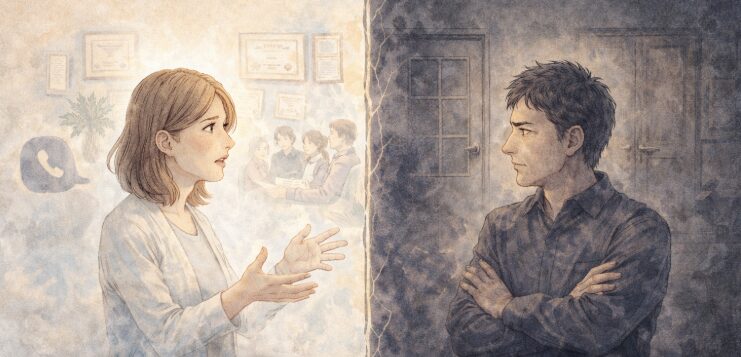
The behavioral differences caused by innate brain-based developmental disorders, and those caused by growing up in an abusive or neglectful environment, can look strikingly similar from the outside. Yet their origins are entirely different — and so is the support each requires.
One reason misdiagnosis happens so often is that the problems of the abusive parent are frequently invisible to those around them. Some clinical settings have noted that parents with mild intellectual disability or borderline intelligence can appear knowledgeable and socially functional in superficial interactions — meaning the inappropriate caregiving happening at home goes unnoticed for years. When that happens, only the child’s behavioral differences surface in school or medical settings, and a developmental disorder diagnosis follows.
When Language Doesn’t Develop
A baby’s language is built through the caregiver’s voice. “Good morning.” “Are you hungry?” “Isn’t that beautiful?” — these everyday exchanges grow a child’s capacity for language. In households marked by neglect or abuse, this voice is drastically absent. Or when it does appear, it comes as screaming or contempt.
The result is delayed language development. “Help me” brings no help. “I’m sorry” brings no forgiveness. In an environment where words don’t serve their function, the child stops trusting words. The capacity to engage with the world through language fails to grow at its root.
From the outside, this is nearly indistinguishable from the language delays of intellectual disability or Autism Spectrum Disorder. But there is a characteristic feature in the language delays of abused children: when placed in an appropriate caregiving environment, they often catch up rapidly. That kind of rapid recovery is rarely seen in delays caused by innate developmental disorders.
One child had barely formed two-word phrases past the age of five and was referred for assessment of intellectual disability. After abuse was discovered and the child was placed with foster parents, vocabulary expanded dramatically within six months, and age-appropriate conversation became possible. The “delay” was not a brain disorder — it was the environment itself, one that had offered no language.
Children Who Fear People — and Children Who Get Too Close
A child raised under verbal abuse and physical harm fundamentally fears other people. They are extremely reluctant to form friendships and avoid interaction wherever possible. This can be mistaken for the low social interest seen in Autism Spectrum Disorder.
Having never been treated as an equal, relationships with peers become distorted. The child may go to extreme lengths to fulfill others’ demands, or turn aggressive to protect themselves. They come to be seen as “a bit different.”
One clinician has described children raised by parents whose difficulties are invisible from the outside in this way: before the child develops the capacity to recognize that the parent is wrong, they are already swallowed whole by contradiction and chaos. A child in that position has never experienced human relationships as safe. Their fear of others is not a “personality trait” or a “disorder characteristic” — it is the natural response of someone who learned to survive.
But some children show the opposite reaction. When raised in neglect or with constantly changing caregivers, they approach even strangers with excessive familiarity. Having never experienced stable human connection, they approach everyone indiscriminately. This behavior is easily confused with the poor sense of interpersonal distance seen in ADHD.
The Truth Behind “Can’t Sit Still”
Many children who grew up with abuse are described as unable to sit still. Fidgeting in class. Reacting intensely to small sounds. Sudden outbursts. These look strikingly like ADHD’s hyperactivity and impulsivity.
But much of this “restlessness” comes from hypervigilance — a state of constant alertness to danger. A brain that has spent years in an environment where the next blow or outburst could come at any moment simply does not know how to stand down. Even in the safety of a classroom, the brain cannot register that it is safe.
Some children who struggle with group settings are simply children who were never taught social rules. A child who has lived with unpredictable violence at home is genuinely confused: the rules for “how not to make someone angry” are completely different between home and the rest of the world.
One child kept turning to look at the classroom door throughout lessons, and flinched at every small sound. The teacher suspected ADHD hyperactivity and raised the possibility of medication at a support meeting. Later it emerged that this child had been experiencing daily violence at home. In the classroom, the body simply could not stop asking: “Is this the moment?”
When “Testing Behavior” Is Mistaken for Problem Behavior
Among the behaviors observed in children who grew up with abuse, there is a pattern often called “testing behavior.” It appears as a cluster of actions that seem incoherent from the outside: provoking an adult to anger, violently rejecting kindness that is offered, then clinging excessively moments later. These patterns repeat in support settings.
The common explanation is that the child is “checking whether this adult is safe.” But as described below, these children have no room to be “testing” anything. The underlying reality is that this behavior is an involuntary defensive reaction — what happens when the protective wall of endurance built for survival is suddenly threatened by warmth.
When these behaviors are observed in an elementary school setting, they tend to be evaluated as impulsivity or oppositional-defiant behavior, and can lead to diagnoses of ADHD+ODD (Oppositional Defiant Disorder).
The fundamental difference between testing behavior and behavior associated with developmental disorders lies in what might be called “partner-dependence.” Testing behavior occurs in relation to specific people and situations. When there is no trustworthy adult present, it appears; as a stable relationship forms, it naturally decreases. In contrast, behavioral difficulties stemming from innate developmental disorders appear consistently regardless of the quality of care. Recognizing this distinction is the entry point to support that actually fits each child.
The Misunderstanding the Name “Testing Behavior” Creates
❌ Common Misunderstanding vs ✅ What Is Actually Happening
❌ The misconception
“The child is deliberately acting out
to test whether this adult can be trusted.”
✅ The actual psychology
“This warmth is threatening the endurance
that has been keeping me alive. I’m terrified.”
The Psychological Process Behind Testing Behavior
Expected love again and again — and was betrayed again and again
→ The child learns: expecting love is dangerous
Survives by maintaining a wall of endurance: “I will not expect love”
→ This endurance becomes the foundation of the self
A caregiver offers warmth — food, kind words, attention
→ The wall of endurance begins to crack
“I’ve endured so hard to get here. When I leave this place, I’ll have to endure again. Stop.”
→ Intense rejection, anger, flight = what looks like “testing behavior”
This is not an intentional “test.” It is an involuntary reaction — what happens when warmth threatens the defenses built for survival.
The term “testing behavior” gives the impression that an abused child is deliberately testing a caregiver’s love. But these children have no room for that kind of testing.
A child who expected love from a parent — and was betrayed — reaches a decision: “I am weak for expecting love. I will live without expecting anything.” That endurance wavered many times, but the child held it together. It was barely enough to maintain a sense of existence.
When that child is placed in a facility and a caregiver extends warmth — kind words, food, attention — what rises in the child is not gratitude. It is terror. “I’ve endured so hard to get this far. Don’t do this. When I leave here, I’ll have to endure all over again.” Shoving away an offered meal is not testing love. It comes from the terror of the endurance crumbling.
Furthermore, the deep bond between parent and child can only be built within a relationship with one specific person. In a facility where multiple caregivers rotate, this bond is structurally difficult to build. And as long as the possibility of “going home someday” persists, the child cannot truly open their heart to safety.
When testing behavior is happening, the child is not testing the adult. They are desperately asking: “Is it safe to stop enduring?” Whether that is understood or not makes all the difference in the quality of support offered.
Contrasting with these visible behaviors, some children raised in abusive environments appear to cause no “problems” at all. One clinical psychologist has observed that many people who grew up in inappropriate caregiving environments never experience the rebellious phase of adolescence. Having had no safe target for rebellion, they have no choice but to remain “good children” with their self-assertion sealed away. Their psychological development stalls at the elementary school stage, and from the outside they appear quiet and well-behaved. But that very quietness is another form of atypical development in abused children — and one that keeps support from reaching them.
The behavioral differences caused by innate developmental disorders and those caused by growing up in abuse can look identical from the outside. A side-by-side comparison across four dimensions — and what it means when an assessment gets it wrong.


Comments