Unhealthy Pairs Hidden in Plain Sight — Why Abuse Survivors Are Drawn Into Controlling Relationships

Before reading this article, please see What You Should Know Before Reading This Site.

The world is full of pairs. Comedy duos with perfect timing. Best friends who clicked instantly. Couples who complement each other precisely because they are opposites. Healthy pairs bring out the best in each other and accomplish what neither could alone.

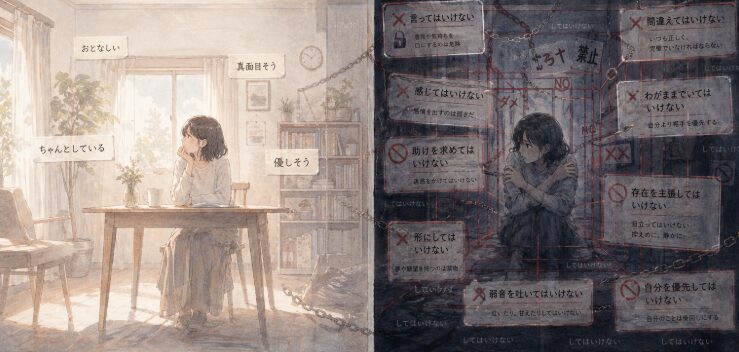
But hidden among the pairs we see every day are relationships with an entirely different structure. One dominates; the other submits. From the outside, they look like friends, coworkers, or a happy couple. But inside, one person is quietly consuming the other.

The One Who Controls and the One Who Is Controlled

In these unhealthy pairs, there is a clear division of roles: the one who dominates and the one who is dominated.

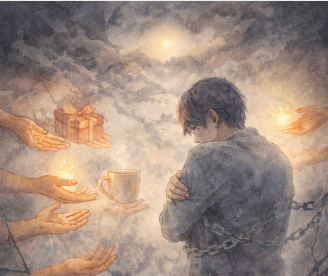
The dominant one is not necessarily violent. In fact, they often approach gently at first. They extend a helping hand when you are struggling, pretend to be an ally, and earn your trust. But that “kindness” has a purpose: to place you under their influence.

Once trust is established, the demands begin gradually. Small favors at first. Then managing your schedule, interfering with your friendships, making decisions on your behalf. “You shouldn’t be hanging out with that person.” “You’d be lost without me.” With words like these, they narrow your world until it contains only them.

Those Most Likely to Be Targeted

Those most likely to fall into the dominated role are people who are already isolated — or trending that way. People who grew up with abuse, who have no safe place to belong, who occupy a socially vulnerable position. These are the people most likely to become targets.

The Sense of Distance That Healthy Upbringing Provides

People who grew up in healthy environments maintain a certain distance in relationships. They exercise reasonable caution with strangers and build trust over time. But for those who never experienced “safety” in childhood, this sense of distance may never have developed.

The Fear of “If They Reject Me, It’s Over”

When someone is kind to them, they believe it immediately. Or, driven by the fear that “if this person rejects me, it’s all over,” they comply with unreasonable demands. The option to “say no” may not even exist in their mind. They have never had the experience of refusing.

Isolation Makes Everything Worse

The absence of someone to say “you should keep your distance from that person” deepens the problem. An isolated person is the most convenient target for a controller.

When Bystanders Look the Other Way

These unhealthy pairs exist in workplaces, schools, and neighborhoods. Sometimes those around them notice the strangeness. But in most cases, no one intervenes.

“Didn’t you know? That person has all kinds of rumors — everyone avoids them.” “Well, it’s partly their fault for not saying no.” “They’re adults — it’s not really our place to get involved.” People say these things and keep their distance. The pair becomes known as “those two” — untouchable, avoided.

The more conscientious people withdraw, the more the relationship becomes a sealed room, and the control grows even stronger.

Where It All Leads

As domination continues over time, the demands escalate. From pushing work and errands onto the other person, it progresses to financial demands. Once leverage is gained, it accelerates — the controller may even insert themselves into the victim’s family.

Where it leads varies — involvement in fraud or drugs, enormous donations to religious organizations, sexual exploitation — but the common thread is that the dominated person loses everything. Money, work, relationships, and their sense of self.

One woman came to rely on a “caring senior colleague” she met at work. At first, it was just work advice. But gradually, the senior began managing her personal schedule, saying things like “Do you really need to hang out with anyone besides me?” The woman got involved in a “side business” the senior introduced, and by the time she realized what had happened, she was hundreds of thousands of dollars in debt. She only recognized something was wrong after she had lost everything.

These relationships share the same structure as parent-child abuse. In a relationship defined by a power imbalance, the weaker party becomes unable to escape.

Why Abuse Survivors Are Drawn Into “Unhealthy Pairs”

It is well documented — both statistically and clinically — that people who grew up in abusive homes are placed in the “dominated” role again as adults. This is not because they are “weak.” It is because domination feels natural — a sensation formed in early childhood.

“Obedience Equals Safety” — A Learned Response

In parent-child abuse, the child learns that “submitting is the way to maintain this relationship.” Being on the dominated side becomes inscribed in the body as “a normal relationship.” As a result, when building new relationships in adulthood, being near a controlling person can paradoxically evoke a strange sense of familiarity — even nostalgia. The body is drawn to a pattern it recognizes, and it cannot escape.

Repetition Compulsion — Unconsciously Replaying the Past

One counselor calls this phenomenon “repetition compulsion.” People unconsciously try to repeat unresolved experiences — driven by an unspoken impulse: “Maybe this time I can make it work.” A child who survived abuse learned to believe that “if I behave correctly, this relationship will succeed.” When a similar relationship appears in adulthood, the body tries to repeat that “lesson.” This is not weakness or foolishness — it is a psychological mechanism that developed for survival.

One psychology expert explains it this way: it is not uncommon for a woman who suffered domestic violence to finally leave her partner after great struggle, only to find that the next person she chooses is also violent. From the outside, it seems baffling — “Why would someone choose the same suffering again?” But the person has no awareness of doing so. Deep in their psyche, the belief that “if I hope, I will be betrayed” and “I cannot be happy” drives them to attract the same pattern of partner, as if to keep proving it true. And each time they are hurt again, they whisper “I knew it” — that confirmation is the very essence of repetition compulsion.

The Hunger to “Be Needed”

For those who never developed the sense that “I have value,” the feeling that “someone needs me this much” carries extraordinary weight. The initial “kindness” is received as a far greater salvation than it would be for others. This becomes the gateway into a controlling relationship.

Moral Harassment and Mother — How Abuse Changes Form and Repeats

A controlling partner and a controlling parent share strikingly high commonalities. Manipulating the other’s emotions. Justifying their own behavior and never apologizing. Finding it easier to maintain the relationship when the other person is weakened — the behavioral patterns of a morally harassing partner and an abusive parent are remarkably similar.

One woman, reading a book that listed the characteristics of moral harassment, realized that replacing the word “husband” with “mother” throughout produced not a single discrepancy. Self-justification, lying without remorse, feeling no guilt whatsoever — these were her husband’s traits, and simultaneously the exact image of the mother she had known since childhood. But what shocked her even more than that recognition was the realization about herself: “No matter how I was treated, I could only keep loving my mother.” People who remain with a controlling partner are often blamed — “It’s your fault for not leaving.” But that structure was already complete in childhood.

The Borderline Intelligence Connection

This is not coincidence. These two types of people share a cognitive commonality. The behavioral traits of domination — self-justification, lying without hesitation, never apologizing, an inflated and fragile pride, ruthlessly exploiting the vulnerable — emerge most strongly in the “borderline intelligence” range, which sits at the boundary with normal intelligence. Because these individuals do not meet the criteria for intellectual disability, they blend into society as “ordinary people,” yet they carry cognitive characteristics that make abstract self-reflection and emotional regulation particularly difficult. It is not uncommon for both morally harassing partners and abusive parents to occupy this same cognitive range — which is why their behavioral patterns match so strikingly.

However, this does not mean that “all people with borderline intelligence are controlling.” Controlling behavior emerges when borderline intelligence combines with other factors — the person’s own upbringing, social learning, and more. The intelligence factor should be understood not as the “sole cause” of controlling behavior, but as “one contributing background factor.”

When People with Normal Intelligence Sense “Something Is Off” and Walk Away

People with normal intelligence, as they interact with someone in this cognitive range, develop a sense that “something is off” and naturally distance themselves. “What they say and what they do don’t match.” “There are areas where communication just doesn’t connect.” These feelings accumulate, and they pull away before the relationship deepens. But for someone who grew up in an abusive home, this sensor does not function. They have spent years learning to convert the feeling of “something is wrong” into “it must be my fault.”

Why They Accept It Even When They Sense Something Is Wrong

So when someone in the borderline intelligence range approaches, the survivor notices the discomfort but accepts it anyway. A person who quickly identifies vulnerable targets and locks down the relationship — someone with the same behavioral patterns as the family they once knew — and before they realize it, they have been absorbed. “Why couldn’t I leave that person?” This is not a matter of willpower. In the body’s experience, leaving that relationship is indistinguishable from leaving the only “family” they ever knew in childhood.

Breaking Free from the “Unhealthy Pair”

What is needed to escape a controlling relationship is, first, the recognition that “this is a controlling relationship.” But this recognition itself is difficult. A familiar relationship pattern looks like “this is normal.”

The Trap of “This Is the Best I Can Get”

Even relationships that an outside observer would see as clearly unhealthy can feel to the person inside like “this is the best relationship available to me.” For those who never developed a sense of boundaries, it is difficult to detect where violation begins.

No Realization Comes Too Late

Many people realize in the course of recovery that “that was domination” only after the fact. That realization is never too late. There is no need to blame yourself for not noticing sooner. From the moment you realize it, you can begin — slowly — to rebuild the sense of “protecting yourself.”

As a concrete first step, you can begin by finding one person who can hear your situation put into words. Anonymous counseling services exist for this purpose. “It’s not serious enough to consult anyone about” — you may feel that way, but that feeling itself may have been formed within the controlling relationship. Borrowing a third party’s perspective can be the first catalyst for realizing “this was not normal.”

Related Articles

FAQ

References

Herman, J. L. (1997). Trauma and Recovery: The Aftermath of Violence — From Domestic Abuse to Political Terror. Basic Books.

Van der Kolk, B. (2014). The Body Keeps the Score: Brain, Mind, and Body in the Healing of Trauma. Viking.

Bancroft, L. (2002). Why Does He Do That? Inside the Minds of Angry and Controlling Men. Berkley Books.

Walker, L. E. (2009). The Battered Woman Syndrome (3rd ed.). Springer Publishing.

About This Article

This article is published by Kokoro Note (こころノート), a Japanese-language website that provides in-depth information about child abuse, its psychological impact, and pathways to recovery. Our content draws on clinical research, the lived experiences of survivors, and insights from professionals working in child welfare. This English edition is offered to make these perspectives accessible to a wider audience.

Let's share this post!

Comments

To comment

TOC
閉じる