This article is written for abuse survivors. If this is your first time here, we recommend reading the previous article first.
“Children who were abused grow up to abuse their own children” — this deeply entrenched belief has caused immense suffering for abuse survivors. Yet the latest research shows that the concept of “intergenerational transmission of abuse” has been profoundly misunderstood.
In the previous article, we traced the history of research on the abuse cycle, showing how figures once cited at 70–90% have been revised to approximately 30% (25–35%)※1. This article goes deeper — into the core of that misunderstanding.
Chapter 1: Judith Herman’s Words
Dr. Judith L. Herman, a leading researcher on childhood trauma, left an important observation on this subject※2. In summary:
In extreme cases, survivors may harm or fail to protect their own children.
However, the vast majority of survivors neither abuse nor neglect their children.
In fact, many survivors deeply fear that their children will share the same fate — and work tirelessly to prevent it.
This blog fully supports this view. Having been abused does not make someone an abusive parent. Far more commonly, survivors are left with profound anxiety about their own parenting.
Chapter 2: What the “30% Cycle” Really Means
As we saw in the previous article, the latest research puts the intergenerational transmission rate of abuse at approximately 30% (25–35%)※1. But what does this 30% actually mean?
→ Previous article: Why People Believed “Abuse Always Cycles” — And What the Research Actually Shows
Some physicians noticed a connection between the rate at which abuse appears to cycle — approximately 30% (25–35%) — and the genetic inheritance patterns of a specific condition. That condition is mild intellectual disability (IQ 50–70) or borderline intellectual functioning (IQ 70–85).
When a parent has mild intellectual disability or borderline functioning, those cognitive characteristics are estimated to be passed on to a child in approximately 20% of cases※3. When both parents have cognitive limitations, the likelihood increases further. While 25–35% and 20% are not an exact match, they fall in the same general order of magnitude — a connection that some researchers have cited as meaningful.
Psychiatrist Dr. Kazumi Takahashi and colleagues proposed the following hypothesis: it is not the past experience of abuse that drives present-day abuse — it is mild intellectual disability or borderline functioning that is most often the true driver.
In other words: what appears to be the “experience of abuse” cycling from parent to child may actually be the inheritance of cognitive characteristics — not trauma itself.
Chapter 3: “Abuse Experience” vs. “Inheritance of Cognitive Traits”
This perspective fundamentally changes how we understand the causes of abuse.
The traditional “abuse cycle” explanation holds that traumatic experience is itself the cause — that suffering creates a pattern that repeats across generations. But through the lens of cognitive functioning, the structure looks entirely different. A parent with cognitive limitations may struggle to parent effectively, resulting in abuse. If those cognitive characteristics are passed to the child, that child may face the same difficulties when they become a parent. From the outside, it looks like “the cycle of abuse is continuing” — but what is actually being transmitted is not the experience of abuse, but cognitive characteristics.
As explored in other articles on this site, people with mild intellectual disability or borderline functioning may find it difficult to take another person’s perspective or regulate their emotions — both of which are critically important parenting skills. When these capacities are limited, a parent may unintentionally harm their child.
Crucially, this is not a matter of malice or cruelty. Cognitive limitations the person may not even be aware of can create serious difficulties in parenting. This is precisely why framing the problem as “the experience of abuse cycling” offers no clear path to solutions.
Chapter 4: To Survivors
If you have a history of being abused, you may carry the fear: “What if I do the same thing to my child?”
The data shows that 70% of people who were abused do not go on to abuse their own children※1. And behind the 30% who appear to continue the cycle, it is likely not the experience of abuse itself, but the inheritance of cognitive characteristics, that plays a role.
“Knowing the statistics doesn’t make the fear go away” — that feeling is entirely understandable. Survivors of abuse who feel deep anxiety about their own parenting are responding naturally, and that anxiety is itself evidence of how seriously they take their child’s wellbeing.
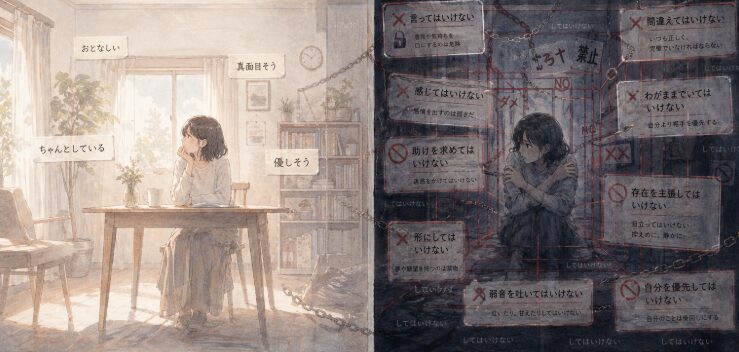
The fear of hurting your child is not something you can simply confide in others. The fear of being misunderstood — of being seen as unfit to be a parent — keeps those words locked inside. Carrying that weight alone is entirely natural. And so, to whoever has been reading this while bearing that weight alone: you no longer need to be haunted by the myth that “abuse always cycles.”
参考文献・出典 / References
※1 Kaufman, J. & Zigler, E. (1987). “Do abused children become abusive parents?” American Journal of Orthopsychiatry, 57(2), 186–192. This study found that approximately 30% (±5%) of people with a history of abuse go on to abuse their own children, demonstrating that the vast majority (∼70%) do not continue the cycle.
※2 Herman, J. L. (1992). Trauma and Recovery. (Japanese trans.: 『心的外偉と回復』, trans. Hisao Nakai, Misuzu Shobo, 1999.) Provides clinical evidence that the large majority of abuse survivors do not abuse their own children.
※3 Twin studies have shown that cognitive ability has a heritable component (Bouchard, T. J. & McGue, M., 1981, Science, 212(4498)). However, this research addresses the heritability of general intelligence and is not a direct source for the specific rate at which mild intellectual disability or borderline functioning is transmitted to children. The “approximately 20%” figure in the text is a rough estimate based on the clinical hypothesis of Dr. Kazumi Takahashi and colleagues, and should not be treated as confirmed scientific evidence.
The following is a reflective reading piece, separate from the analytical content above, describing the journey of a survivor-turned-parent finding their way to recovery through raising a child.
Epilogue: Beyond the Cycle — When the Bond Between Parent and Child Begins to Heal
When abuse survivors become parents, their parenting is often built on a foundation of fierce determination: I will not let this happen to my child. But beneath that determination lies a quiet difficulty — the sheer unfamiliarity of what a child actually is.
Asking for the same picture book page again and again. Calling out “Look at me! Look at me!” repeatedly. Crying one moment, laughing the next. These natural expressions of childhood can feel baffling to a parent who grew up in a household where showing emotion was forbidden. “Why do they keep doing that?” can be a genuine question, not impatience.
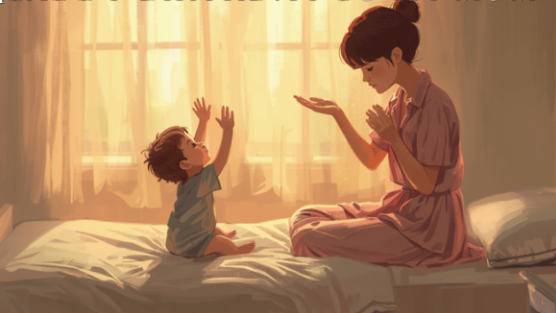
For a parent who never experienced being cared for as a child, caring for a child can stir something unexpected: a hunger for that care themselves. Sometimes, in playing with their child, a parent is quietly tending to the child they once were — the part of themselves left behind. This is not something to be ashamed of. It is not selfishness. It is the quiet work of reparenting.
“A tadpole raised a frog.” This phrase, sometimes shared among survivors, captures something real: a parent who never learned to be a child, raising a child who shows them what childhood looks like. Slowly, haltingly — and sometimes, beautifully.


Comments