“People who were abused will go on to abuse their own children.” This claim has stubborn currency.
For someone with no connection to abuse, it may sound like idle gossip. For someone who actually grew up in an unhealthy caregiving environment, no other phrase carries this much weight.
For someone preparing for a birth, or already raising small children, the word “cycle” sits like a curse.
“Will I End Up Becoming Like That?”
A child knows only the parenting their own parent gave them.
They might catch glimpses of difference at a friend’s house, but in most cases, the parent’s parenting is “normal” to them.
In a dysfunctional home, “abuse = discipline = parenting” can collapse into one. Violence and silence become the only model of caregiving the child has ever seen.
With age, moments arrive in which the survivor realizes “what was done to me was not normal.” And at the moments of pregnancy and birth, that recognition turns instantly into terror.
I cannot find my own child cute. Their crying frightens me.
Anyone who feels that way about their own baby must be a terrible person. In the brutal exhaustion of postpartum, the survivor begins to think they understand the “reason” their parent did what they did.
I, too, will eventually do the same thing —
The Fact of Being Afraid Already Tells Us Something
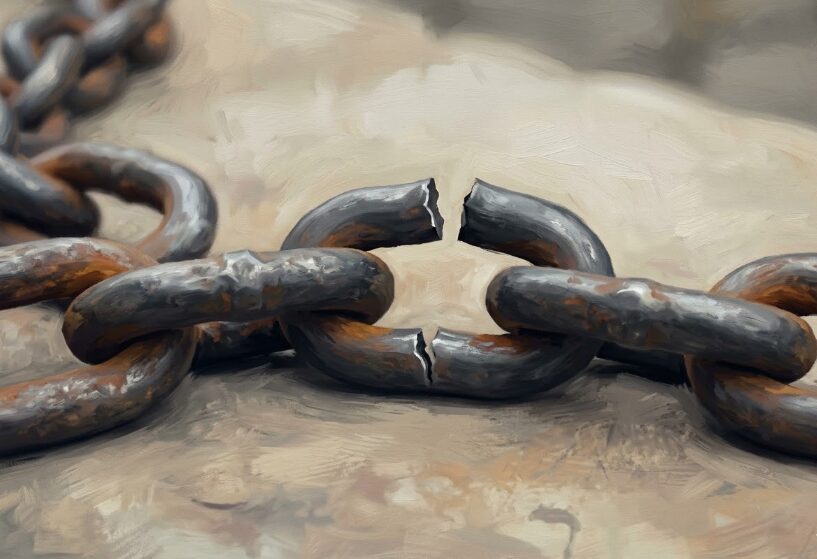
Most people who carry the dread “am I going to do this myself?” do not in fact go on to repeat it. The very capacity to fear it — the capacity to recognize the act as wrong — is the strongest evidence that the chain is already, structurally, broken.
An abusive parent in the act does not carry the fear “what I am doing is abuse.” A parent who can carry that fear is, by virtue of carrying it, already far away from being that parent.
Why Cycles Happen — A Psychological System With Good and Bad Reversed
Some people, however, carry the suffering “I’m afraid of it, and it still happens.” To understand why, you have to look at the unusual psychological structure that forms inside someone raised under abuse.
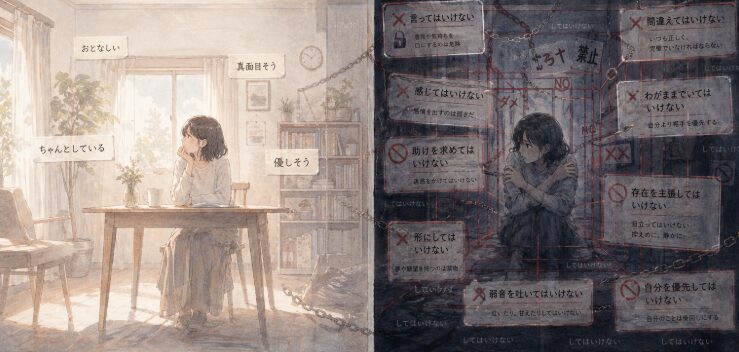
By default, humans confirm their own existence by having needs met. The infant cries “I’m hungry” and gets fed; through that repetition, the sense “I am allowed to be here, I am welcome” takes root.
A child raised under abuse is denied every time they assert themselves.
Cry, and get hit. Say “this is scary,” and get told “that’s not scary.” Show feeling, and be punished. So the child learns, in order to survive: enduring the urge, suppressing the self, becomes the proof that they exist.
This inversion flips the very sense of “right and wrong” too.
However unreasonable the parent in front of them is, the child must obey. To endure and obey becomes “living”; it becomes “good.”
To run, to resist, to ask for help — these get etched as “bad.”
What happens when a person carrying that psychological system becomes a parent?
They throw themselves at parenting. They discipline themselves, run the household, try to be a good parent. And then the child cries, fusses, freezes — that is, the child doesn’t endure — and intense anger rises in the parent.
The anger is at the child and at oneself simultaneously.
“This weak self that can’t endure is unforgivable” — that feeling slides directly toward the child.
The harder the parent tries, the more that feeling channels itself as anger toward the child.
This is what “what looks like the cycle” actually is.
Not malice and not absence of love. The psychological system the survivor built in order to live is what produces, paradoxically, “what looks like the cycle.”
Why “the Fear” Doesn’t Go Away — The Fear of the Fear Itself
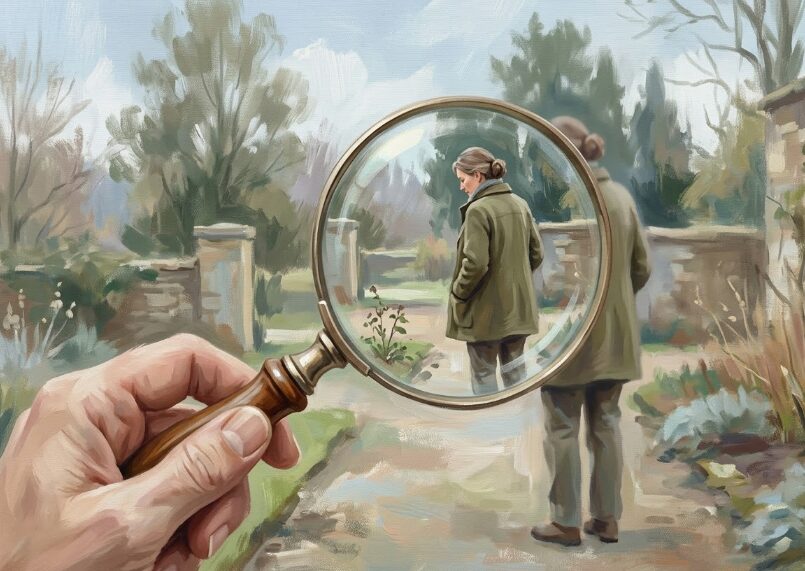
“Breaking the curse of the cycle” is not something achieved by understanding it intellectually. The survivor can know the words “I am not my parent,” and the body still hasn’t caught up. That gap can last for a long time.
In an abusive environment, feeling fear was not the only danger — showing the fear was also dangerous. Crying, shaking, asking for help: when these behaviors had drawn further attack, the act of “expressing fear” itself becomes encoded as a threat.
The result is a doubled fear. On top of the fear of the original memory, there is the fear that “if I show this fear to anyone, who knows what will happen.”
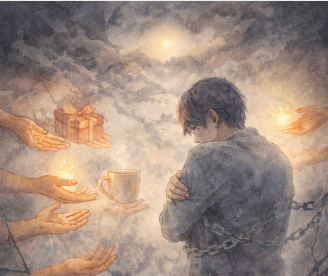
Reaching out to another person, asking for help — when those acts have been learned as life-or-death, recovery does not move forward by “healing the wounds” alone.
Sitting deeper still is “the fear of being happy.” Having held back every want, the survivor cannot let happiness in either, because at some level the body has registered that “wanting” is what gets you punished.
Even So, Things Can Change
If walking through this alone is too heavy, group work is one option.
The “MY TREE Parents Program,” for parents working on recovery after they have crossed into abuse, runs as a 13-week group with two-hour sessions; participants can attend pseudonymously and the program has functioned for over twenty years. For parents struggling with “I keep taking my irritation out on the child,” the Children’s Center for Abuse Prevention (CCAP) Group Care is another option.
The weight someone has carried alone for years gets shared, in such a setting, with people who carry the same. That space can become the first place a survivor experiences “it’s okay to lean.” Coming to believe “I will not pass this on” is itself one of the shapes recovery takes.


Comments