In the previous article, we examined the “foundation” that distinguishes healthy relationships from unhealthy ones — how that foundation is laid inside the home.
This article picks up from there. The focus shifts to what waits after one leaves home — the “other side” of the pair. Who exactly is the person who dominates? How do they choose their targets, and how do they slowly narrow the relationship around them? Why does leaving feel so impossible? These are the questions this article unpacks.
The Reality of the One Who Dominates
Hidden inside ordinary-looking human relationships, the pair often passes unnoticed. But the reality is simple: one person dominates, the other yields. The one who dominates is often praised by those around them as “caring” or “a natural leader” — but that is only the surface. Quietly, one person is being worn down by another.
They manipulate the other person’s emotions. They justify their own actions and never apologize. They lie without flinching, reshaping any story into whatever serves them best. They twist the other’s words on the spot and recast themselves as the victim. They barely register that they have done anything wrong. They remember the other person’s weak points and pull them out when needed. The weaker the other becomes, the easier the relationship is to maintain. Their pride sits unusually high. They use those in a weaker position to the fullest.
Without someone moving the way they want, they cannot hold the shape of themselves together — a strange form of co-dependency. At the core, this is a person whose weakness requires standing above someone else just to stay intact.
The Eye for Targets
The one who dominates does not target just anyone. They have a clear and trained eye.
Someone who does not push back. Someone who feels guilty when they have to refuse. Someone who reads the room too well and ends up adjusting to whoever is in front of them. Someone with no allies, standing alone.
They are skilled at spotting these traits. People who grew up in unhealthy households, who tend to carry all of these traits at once, are especially likely to become the chosen ones.
If there is no one around the chosen person to say “you should keep your distance from that one” — or if there are very few such voices — the situation worsens quickly. An isolated person is, for the one who dominates, the most convenient target there is. Once the judgment is made — “this one can be dominated” — the target is set.
The Process of Erosion
The one who dominates is not necessarily controlling or violent from the very start.
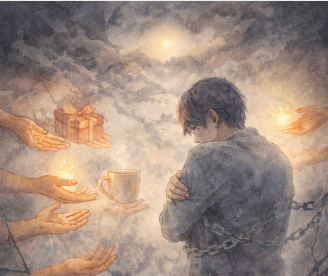
At first, the approach is gentle. A hand reaches out where you are struggling. They play the part of an ally. They earn your trust. They behave in such a way that you find yourself thinking, “no one has ever cared about me this much before.”
Once the trust is in place, the demands begin — gradually. At first, small favors. Then, slowly, they begin managing your schedule, commenting on your friendships, making decisions on your behalf.
“You really shouldn’t be hanging out with that person.” “You can’t function without me.”
— With words like these, they narrow the other person’s world down until only they remain inside it.
But it does not end with narrowing. A controlling person will also set out to destroy, from within, the trust between you and the people around you.
One way is to get you to tell small lies for them. “Keep this between us.” “Just tell them this.” At first the lies are trivial. But the one doing the lying is slowly worn down by the guilt of deceiving people they care about. And sooner or later, the lie comes out. When it does, the one who loses people’s trust is not the one who set it up — it is the one who told the lie. One by one, the people who were on your side drift away.
Another way is to plant trouble around you. They get you to cancel plans at the last minute, scold you in front of others, and make you someone others find hard to be around. As people begin to keep their distance, they simply watch in silence for a while. Then, once you have nowhere left to go, they offer a hand.
Both tactics aim at the same thing: to leave the controlling person as the only place you can turn. One escape route at a time, every way out is sealed.
By the time the relationship has deepened, the one being dominated can no longer decide anything without going through the other. What to wear, whom to meet, what to believe — every small choice passes through the dominant figure first and only comes back from there. Everyone else has drifted away, and the only person left to confide in is that one person. Before you realize it, you have become someone whose every move hinges on the other’s mood.
When the domination continues long enough, the demands escalate.
What begins as offloaded work and unwanted errands turns, before long, into demands for money. Once weaknesses are known, the pace accelerates. The dominant figure starts reaching into the family of the one they have chosen. The trajectory can stop at workplace overload and everyday verbal abuse — or it can move further, into financial exploitation, the closing-off of all other human ties, and, further still, into fraud, complicity with drugs, enormous donations to a religious group, even sexual exploitation. What every version has in common: the one being dominated loses everything. Money. Work. Relationships. And themselves.





Comments