When you grow up under a parent who treats their children differently, the relationships between siblings are also shaped by the parent’s hand. “Only that one was loved.” “I was the only target.” “I was never even on the list.” Survivors already know these as feelings — but the structure underneath is harder to put into words.
This article walks through that structure, in order: the shape of the assigned roles, how the roles shift, why the parent does this, and how to step out of the role.
A Map of Sibling Discrimination
Sibling discrimination is the parent inside the home assigning visibly different treatment to different siblings.
Looked at structurally, several elements come into view.
First, the “roles” the parent assigns. The Favored Child who gets indulged. The Scapegoat who gets used as the outlet. And in some families, a child who barely receives any attention at all — the Forgotten Child.
Second, the dynamic property of the roles. The roles look like they were assigned for the child’s character, but in fact they were dealt according to the parent’s convenience — so when the parent’s circumstances change, the roles get reassigned.
Third, a “wedge-driving” maneuver that runs alongside discrimination but is technically separate. Some parents actively work to keep their children at odds with each other.
From here, this article walks through these three lenses in order. The typical externally visible shapes of sibling discrimination are covered in a separate entry-level article.
The Roles a Parent Assigns
The Favored Child
The child who is loved, praised, given resources. From outside, the lucky one. Internally, however, the favored child sits in a strange position: they witness, daily, the parent’s harshness toward their sibling.
This is structurally close to “exposure to domestic violence between adults.” Witnessing harm — even without being the direct target — is recognized in Japan as a form of psychological abuse. Children who only witness verbal and physical abuse have been documented to suffer atrophy of the visual cortex (interpreted as the brain adapting in order to “not remember what was seen”), and to develop PTSD, complex PTSD, depression, anxiety, aggression, and cognitive delays. Witnessing verbal abuse has been shown to have a neurological impact comparable to that of witnessing physical abuse.
For the favored child, the imbalance — “I am loved, my sibling is not” — concentrates guilt and helplessness. “Am I the reason my sibling is taking the heat?” “I want to help; I can’t.” “I might be the next target.” Caught in those feelings for years, the favored child also tends to push their own pain out of sight, telling themselves “I was the indulged one, I have no right to complain.”
A second branch: joining the parent in attacking the sibling
The favored child does not always end up in guilt and helplessness. There is a second branch: aligning with the parent and joining in the attack on the abused sibling.
In psychology this is called “identification with the aggressor.” The child internalizes the qualities of the threatening parent and behaves the same way, in order to control their own anxiety. “If I act like the perpetrator, I won’t be the next target.” That is the self-defense underneath.
The Scapegoat
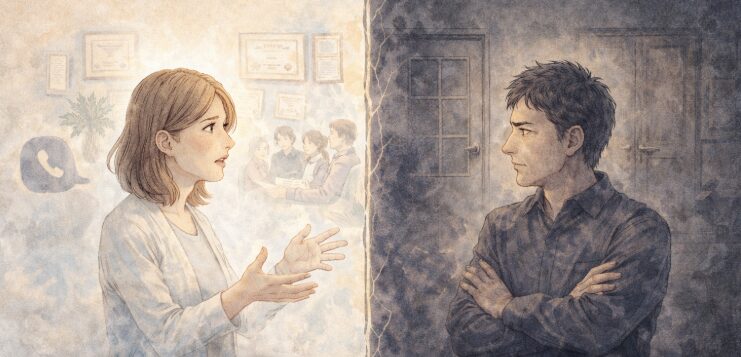
The scapegoat is the sibling singled out as “the difficult one,” the one who absorbs the parent’s anger. The reason is never explained, even after the child grows up.
One survivor: “It was always me. The hits, the lockouts on the front step. There was a rainy day I was made to stand barefoot at the gate. Through the glass I could feel the others having dinner inside, normally. The reason I was hated I never figured out. Once I left for trade school, I have not seen my mother since.”
The scapegoat, taking on the family’s unjust anger over years, comes to believe “there must be something fundamentally wrong with me.” Without that belief, what is happening cannot be made sense of. Believing it is itself one of the psychological devices used to keep going without throwing the self away.
What stays with the scapegoat: an anger with nowhere to go
What tends to stay with a scapegoated sibling is low self-esteem and an unanchored anger. “The other siblings were loved; I was not” gets converted into “I must have a fundamental flaw,” which is hard to dispel through effort.
Anger toward the parent also has nowhere to go. Sibling discrimination gets processed as “an extension of ordinary parenting,” making it difficult to have it recognized as abuse even when reported. The anger gets turned, instead, on the favored sibling, or pressed back inside the self where it surfaces as depression or eating disorder.
Even into adulthood, many cannot say anything to the parent, and clinics receive consultations like this: “I was the scapegoat; I resent my parent. But I cannot say a word about it to them. A black, sealed-off feeling sits in the very bottom of me.”
The scapegoat does not have the “second branch” available to favored or forgotten children. They are the family’s target. Without an ally inside the family, they either survive until they leave home, or carry the stuck anger into adulthood.


Comments