Before reading this article, please see What You Should Know Before Reading This Site.
How “Normal” Families Think About Parent–Child Bonds
“Parents always have their children’s best interests at heart.” “Family members can always understand each other.” These are shared assumptions among people who grew up in ordinary households.
People from typical families occasionally talk about their parents with friends or coworkers. “My mom is so nosy,” “My dad was strict,” “We had a huge fight when I was in high school.” Even while venting, both speaker and listener sense an underlying warmth — a fundamental bond that was never truly broken. These complaints are safe precisely because the relationship beneath them is secure.
Arguments between ordinary parents and children are often the flip side of parental concern. They are a healthy exchange of anger — a sign of the child’s emotional growth and the parent’s engagement. Beneath the conflict lies mutual respect.
What “Parent” Means to Abuse Survivors
For those who grew up in abusive households, the word “parent” carries an entirely different meaning. A parent was not someone who offered safety — a parent was the source of fear. The assumption that “parents and children can understand each other” simply never existed for them.
Yet the world keeps speaking to them from that assumption. “I’m sure your mom didn’t mean any harm.” “You’re family — you’ll work it out eventually.” These words come from genuine kindness. But they wound deeply, because the “family that understands each other” never existed in the survivor’s reality.
The Pain That Never Gets Through
Most people feel heartbroken when they hear news stories about children who died from abuse. But imagining the ongoing pain of adults who survived abuse is far more difficult.
One woman once tried sharing a small part of her childhood during a casual conversation with a coworker. “My family was kind of complicated… my mother would hit me when she got angry.” Before she could say more, her coworker — with the best of intentions — replied, “But I’m sure she loved you in her own way.” The woman couldn’t continue. She smiled and said, “Maybe.” On her way home, she thought, “I shouldn’t have said anything.” In that moment, her experience had been absorbed into the framework of “normal family arguments” — erased as if it were nothing unusual.
Why Survivors Minimize Their Own Pain
Abuse survivors tend to underestimate their own experiences. They try to convince themselves that “it wasn’t that bad.” As a result, when they do speak to others, they describe horrific experiences in understated terms — and listeners mistake devastating abuse for ordinary “family disagreements.”
One counselor explains: “When abuse survivors downplay their experiences, it is not weakness — it is the result of years of training.” People who have spent their lives managing the gap between their public self and their inner reality have automated that management. They say “It wasn’t a big deal” while silently drowning in pain. This two-layered existence is, in one sense, a form of strength — they survived by maintaining it. But it also prevents them from communicating what actually happened. Minimization is self-defense, a long-practiced survival strategy.
The Weight of “Just Get Over It”
“That was so long ago — just move on.” “At least you survived, right?” These are the kinds of responses survivors receive.
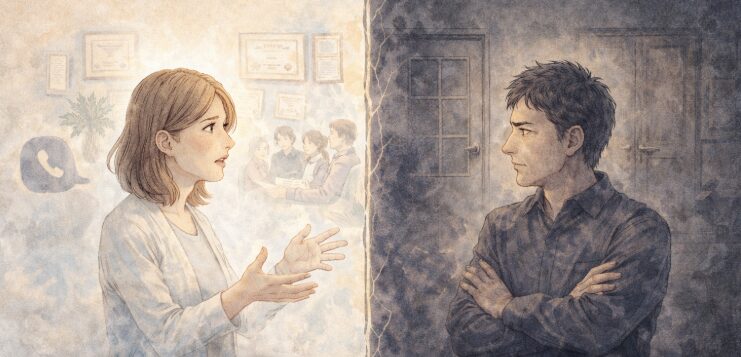
Having your pain completely fail to reach another person — being utterly ununderstood — is a double suffering, and a profound loneliness. The wall between the two sides is built from radically different childhoods. Neither side is at fault. But the one who is hurt, even by well-meaning words, is always the survivor.
If someone confides in you about difficulties with their parents, please set aside your own family experience for a moment and simply listen.
Aversion to the Unknown — Why Survivors’ Stories Fail to Land
What happens when someone from an ordinary family listens to an abuse survivor’s story? Even while genuinely trying to understand, something inside them resists. “That can’t be right.” “Isn’t that an exaggeration?” These reactions arise almost automatically.
The Aversion Comes from Experiential Gaps, Not Malice
This is not malice. Human beings tend to perceive things beyond their own experience as nonexistent. For someone whose body carries the imprint of “parents and children understand each other,” the reality of “my parent never once understood me” lies outside the realm of imagination. And what lies beyond imagination can look like a lie or an exaggeration.
The Accumulated Despair of Never Being Understood
Many survivors have accumulated years of despair from not being understood. They speak, and it doesn’t get through. Because it doesn’t get through, they stop speaking. Because they stop speaking, people assume “it must not have been that bad.” This vicious cycle deepens their isolation with each turn.
“Understanding” Was Never a Given — It Was Built Over Thousands of Moments
Where does the feeling that “parents and children understand each other” actually come from? It is not something people are born with. It is constructed through repeated experiences in early childhood.
A child cries, and the parent responds. A child gets angry, and the parent absorbs it. A child feels joy, and the parent celebrates with them. When “I expressed an emotion and someone received it” happens hundreds, thousands of times, the sense that “this person understands me” becomes physically imprinted.
One counselor puts it this way: “A ‘normal parent’ is someone who involuntarily feels their child’s emotions as their own.” When the child is sad, the parent’s chest aches. When the child is afraid, the parent becomes anxious. This emotional resonance forms the foundation of “understanding each other.” A child born to a parent in whom this circuit never functioned grows up never once experiencing what it means to be understood by a parent.
The Day Someone Received the Full Weight of the Fear — The Miracle of Being Understood
One man describes the moment he first told a support worker about his childhood: “When my father screamed, my body froze. I wanted to run, but my feet felt glued to the floor.” The support worker simply said, “That must have been terrifying.” Not “You’ll be okay.” Not “I’m sure your father had his reasons.” Just an acknowledgment that the fear was real. The man later said, “That single sentence gave a name to something I’d carried for decades.”
“Your Fear Was Real” — The Power of Validation
“The fear you felt was real. It was not exaggeration. It was not weakness.” When survivors hear these words and feel them received without qualification, many describe it as “a kind of miracle.” This is not hyperbole. After years of being told they were “overreacting,” “too sensitive,” or that they should “just forget it,” having their experience accepted as-is carries a transformative weight. It is a turning point in recovery.
Being Understood Is Itself a Form of Healing
Being understood can itself become part of the healing process. For someone who never experienced “being understood,” the moment it finally happens represents a delayed developmental opportunity. At any age, the experience of “someone truly understood me” can be accumulated. Even outside the parent–child relationship, this experience has the power to change a person.
How Society’s Assumptions Isolate Survivors
The societal assumption that “parents and children understand each other” creates a double burden for survivors. The first layer is the pain of having been harmed by a parent. The second is the isolation of being unable to tell anyone about it.
What It Takes to Say “My Parents Were Not Normal”
To say “my parents were not normal,” the listener must first hold the premise that “not all parents are normal.” But most people live with a baseline trust in the institution of parenthood. When someone says “my parent frightened me” or “my parent hurt me,” the listener unconsciously reaches for alternative explanations: “Maybe it was a misunderstanding.” “It probably wasn’t that serious.” The speaker senses this doubt and gradually stops talking.
Isolation That Continues Long After Leaving Home
This isolation persists long after survivors leave the family home. At work, with friends, with partners — there are almost no spaces where the reality of “my parents were not normal” can be shared. When wedding season or holiday visits come around, well-meaning questions like “How are your parents?” land with unexpected force. Each time, the survivor faces the same choice: explain, lie, or smile vaguely and change the subject.
Ending the Cycle of “Nobody Understands”
How should survivors talk about their parents? One thing that can be said: not expecting understanding from the start is itself a form of self-protection. Speaking from the premise that “it’s natural they won’t understand” is not resignation — it is self-defense.
At the same time, there are things the people around survivors can do. When someone begins to talk about their parents, resist the urge to say “my parents were like that too” and instead simply ask, “What was that like for you?” Add one sentence: “That sounds really hard.” Temporarily set aside your own “normal” and face the other person’s reality of what was not normal. That alone can ease a survivor’s isolation.
Related Articles
FAQ
Why do abuse survivors minimize their own experiences?
Minimization is not a sign of weakness — it is a deeply ingrained survival strategy. Survivors learned early to manage the gap between their inner suffering and their outward presentation. Saying “it wasn’t that bad” became automatic, protecting them from further harm but also preventing honest communication.
Why do people from ordinary families struggle to believe abuse survivors?
This is not malice — it stems from experiential gaps. People tend to perceive realities beyond their own experience as nonexistent. When “parents understand their children” is physically imprinted in someone, the concept that a parent never once understood their child lies outside their imagination, making it seem like exaggeration.
What is the most helpful thing to say when a survivor talks about their parents?
Instead of relating it to your own experience (“my parents were like that too”) or offering reassurance (“I’m sure they meant well”), simply ask: “What was that like for you?” Acknowledge the experience with “That sounds really hard.” Temporarily set aside your own framework of normal and just listen.
Can the ability to “understand each other” develop later in life?
Yes. While the foundation of mutual understanding is typically built through thousands of early parent–child interactions, the experience of “being truly understood” can be accumulated at any age. Through therapy, supportive relationships, or a single moment of genuine validation, survivors can begin to build what was missing — it does not have to come from a parent.
References
Herman, J. L. (1992). Trauma and Recovery: The Aftermath of Violence — From Domestic Abuse to Political Terror. Basic Books.
Van der Kolk, B. (2014). The Body Keeps the Score: Brain, Mind, and Body in the Healing of Trauma. Viking.
Bowlby, J. (1988). A Secure Base: Parent-Child Attachment and Healthy Human Development. Basic Books.
This article is an English adaptation of content originally published on こころノート (Kokoro Note), a Japanese-language resource on child abuse, trauma, and recovery.


Comments